
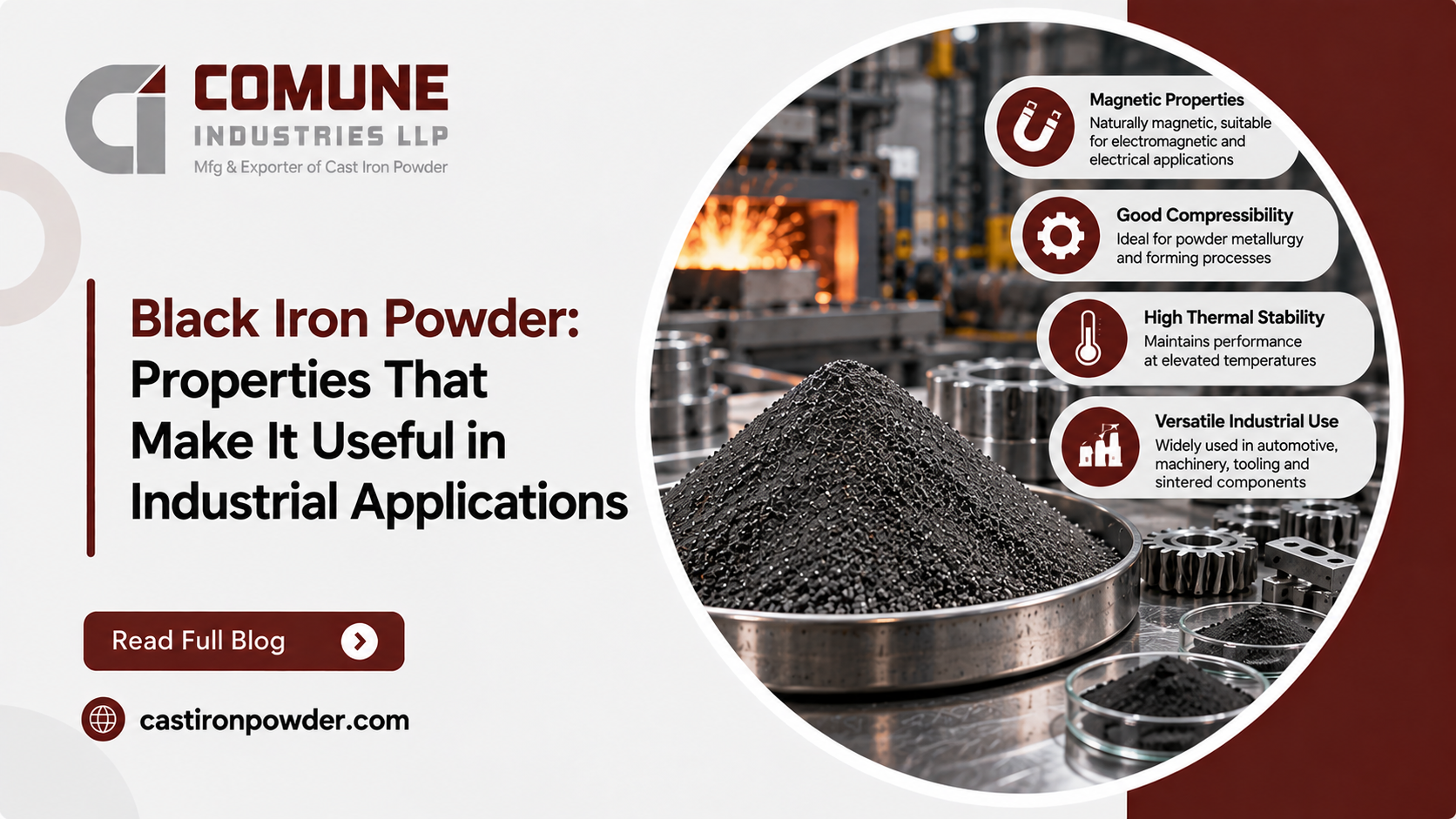
Black iron powder is a finely processed iron-based material used across a range of industrial and manufacturing applications. Its physical characteristics, chemical composition, particle size, purity, and consistency can influence how effectively it performs in a particular production process. As industries increasingly require materials that offer predictable performance and controlled processing, understanding the properties of black iron powder has become important for manufacturers and industrial buyers.
The usefulness of black iron powder depends on more than simply its iron content. Factors such as particle morphology, particle size distribution, bulk density, flowability, compressibility, and surface characteristics can affect processing and final product performance.
For businesses sourcing industrial iron powders, Comune Industries provides iron powder solutions designed around the requirements of different manufacturing applications. Understanding the material before selecting a grade can help buyers identify a product that is technically suitable for their process.
What Is Black Iron Powder?
Black iron powder is a powdered iron material characterized by its dark or black appearance and fine particle structure. It is produced through controlled manufacturing and processing methods that determine its particle characteristics, purity, and physical properties.
Depending on the manufacturing process and intended application, black iron powder can be supplied in different particle sizes and grades. These variations allow manufacturers to select material according to requirements such as compactibility, flow behavior, surface area, and chemical composition.
Unlike bulk iron materials, powdered iron provides a much greater surface area relative to its volume. This characteristic makes it suitable for processes where controlled particle behavior and material distribution are important.
The specific properties of a grade should always be evaluated against the requirements of the intended application.
Key Black Iron Powder Properties
The performance of iron powder in industrial applications is closely connected to its physical and chemical characteristics. Some of the most important black iron powder properties include particle size, purity, morphology, bulk density, flowability, and compressibility.
1. Particle Size and Distribution
Particle size is one of the most important factors influencing powdered iron performance. Fine particles provide greater surface area, while larger particles can offer different flow and handling characteristics.
Particle size distribution also matters because a consistent distribution can contribute to predictable processing behavior. Depending on the manufacturing process, industries may require a specific particle size range for effective mixing, compaction, coating, or other operations.
For this reason, industrial buyers should review particle size specifications rather than selecting powder based only on appearance.
2. Chemical Composition
The chemical composition of black iron powder can affect its suitability for different industrial processes. Iron content, carbon levels, oxygen content, and other trace elements may be considered when evaluating a particular grade.
Consistent chemical composition helps manufacturers maintain repeatable production conditions. In applications where material chemistry directly affects the final product, controlling these parameters becomes particularly important.
3. Particle Morphology
Particle morphology refers to the shape and structure of individual powder particles. Depending on the production method, particles can have different shapes and surface characteristics.
Morphology can influence flowability, packing behavior, surface contact, and compaction. Therefore, two iron powders with similar chemical compositions may still behave differently during processing because of differences in particle structure.
4. Bulk Density
Bulk density describes the mass of powder occupying a specific volume, including the spaces between particles. It can influence material handling, storage, transportation, and compaction processes.
Consistent bulk density is particularly useful for manufacturing environments where accurate material dosing and repeatable production conditions
5. Flowability
Flowability describes how easily powder particles move and transfer during handling. Good and consistent flow characteristics can help with automated feeding, mixing, filling, and dosing operations.
Poor flowability can create problems such as inconsistent feeding, bridging, or uneven material distribution. For industrial applications, evaluating powder flow behavior can therefore be an important part of material selection.
6. Compressibility
Compressibility is another important characteristic when iron powder is used in powder metallurgy and related manufacturing processes.
Powder particles need to respond appropriately to applied pressure during compaction. The ability of particles to pack and form a compact can influence density, shape retention, and subsequent processing.
The compressibility of a particular powder depends on several factors, including particle size, morphology, composition, and surface characteristics.
Black Iron Powder Characteristics That Support Industrial Processing
The combination of different material properties determines the overall black iron powder characteristics observed during manufacturing.
For example, particle size affects surface area and packing, while morphology influences how particles move and arrange themselves. Chemical composition can affect material behavior, while bulk density influences storage and dosing.
These characteristics should not be considered independently. Industrial performance is often the result of how multiple properties interact during a specific manufacturing process.
Consistent material characteristics are especially important in high-volume production. When the incoming powder has predictable specifications, manufacturers can maintain more stable process parameters and reduce unnecessary variations between production batches.
Black Iron Powder Uses in Industrial Applications
The versatility of iron powder allows it to be used across different industrial sectors. The exact application depends on the grade, particle characteristics, purity, and processing requirements.
Powder Metallurgy
One of the important black iron powder uses is powder metallurgy. In this manufacturing approach, metal powders are compacted into specific shapes and subsequently processed to produce components with controlled dimensions and properties.
Iron-based powders are widely associated with powder metallurgy because they can be formulated and processed according to component requirements.
Friction Materials
Iron powders can also be incorporated into certain friction-material formulations. These materials are used in applications where controlled friction and wear characteristics are required.
The appropriate powder grade depends on the formulation and performance requirements of the finished product.
Welding and Related Applications
Iron-based powders may be used in selected welding-related and metal-processing applications. Powder characteristics can influence how the material behaves during processing and how effectively it integrates into the intended application.
Chemical and Industrial Processing
Because powdered iron offers a relatively high surface area compared with larger iron forms, certain grades may be used in chemical and industrial processes where powdered iron is technically suitable.
The specific requirements depend on the process chemistry, particle characteristics, and operating conditions.
Manufacturing and Metal Processing
Industrial manufacturers may use iron powders in various metal-processing applications where controlled particle size, composition, and material consistency are required.
The selection of an appropriate grade is important because different manufacturing processes can demand significantly different powder characteristics.
How Black Iron Powder Performance Depends on Material Quality
Black iron powder performance is influenced by both the powder itself and the way it is processed.
A powder with consistent particle size distribution, chemical composition, and morphology can provide more predictable behavior than material with significant batch-to-batch variation.
For example, inconsistent particle sizes may affect packing and flow, while differences in chemical composition can influence processing conditions. Similarly, variations in moisture or surface characteristics may affect storage and handling.
For manufacturers, quality control is therefore an important consideration when purchasing industrial iron powder. Testing and specification sheets can help buyers understand whether a particular grade matches their requirements.
particular grade matches their requirements.
Factors to Consider When Selecting Black Iron Powder
Choosing the right powder requires more than comparing price per kilogram. Industrial buyers should evaluate the technical requirements of their application.
Important considerations include:
- Iron content and chemical composition
- Particle size and distribution
- Particle morphology
- Bulk density
- Flowability
- Compressibility
- Surface characteristics
- Required purity level
- Batch-to-batch consistency
- Packaging and storage requirements
- Application-specific specifications
The right combination of properties depends on the manufacturing process. A powder that performs well in one application may not necessarily provide the same results in another.
Working with an experienced manufacturer can help buyers understand which specifications are relevant to their particular process.
Importance of Consistent Black Iron Powder Quality
Consistency is an important consideration for industries operating continuous or high-volume production lines. Changes in powder characteristics can influence feeding, compaction, mixing, and final product quality.
Reliable manufacturing processes help maintain consistent material specifications from batch to batch. This can make it easier for manufacturers to establish stable production parameters and monitor process performance.
At Comune Industries, attention to material specifications and manufacturing consistency helps industrial buyers evaluate iron powder according to their application requirements.
Why Choose the Right Iron Powder Grade?
Different industrial applications require different combinations of material characteristics. Selecting a grade based on the actual process can help manufacturers avoid issues associated with unsuitable particle size, density, flowability, or composition.
Before purchasing, buyers should identify the required specifications and communicate them clearly to the supplier. Technical documentation, testing data, and product specifications can then be used to determine whether the powder is suitable for the intended application.
This approach is particularly valuable for manufacturers where material consistency directly affects production efficiency and product quality.
Conclusion
Black iron powder is a versatile industrial material whose usefulness comes from the combination of its physical and chemical properties. Particle size, morphology, chemical composition, bulk density, flowability, and compressibility all contribute to how the material behaves during manufacturing.
Understanding these black iron powder properties can help industrial buyers make more informed material-selection decisions. From powder metallurgy and friction materials to selected chemical and metal-processing applications, the right powder grade can support controlled and repeatable manufacturing processes.
The most suitable material ultimately depends on the specific application, processing conditions, and required product specifications. Manufacturers such as Comune Industries can help industrial buyers evaluate iron powder options based on their technical and production requirements.
For businesses looking for a suitable Black Iron Powder Manufacturer in India, reviewing product specifications and application requirements is an important first step toward selecting the appropriate industrial powder.