
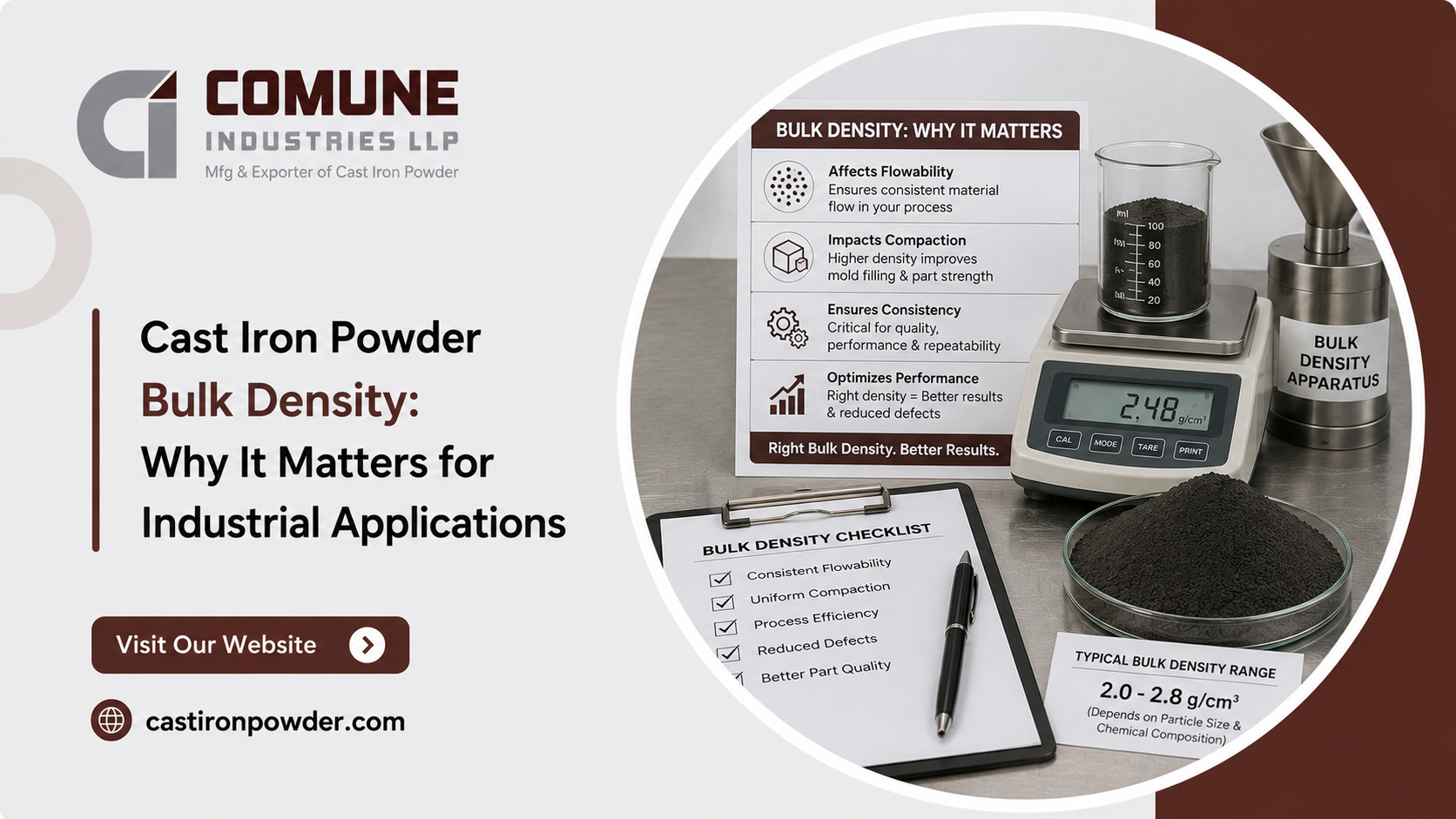
Cast iron powder is used across a wide range of industrial processes, from powder metallurgy and friction materials to welding and surface coating applications. While buyers often focus on chemical composition or particle size when evaluating a powder, one property is just as important but frequently overlooked: bulk density.
Cast iron powder bulk density affects how a powder is handled, stored, packaged, transported, and processed. A powder with a bulk density that doesn't match your equipment or process expectations can lead to inconsistent filling, wasted storage space, and unpredictable production results — even if the chemical composition is exactly on spec.
That said, bulk density should never be looked at in isolation. It needs to be considered alongside other cast iron powder properties, such as particle size, particle size distribution, moisture content, and flowability, to get a complete picture of powder quality.
In this article, we'll break down what cast iron powder bulk density actually means, why it matters for industrial applications, how it's measured, what factors influence it, and what buyers should check before placing a bulk order.
What Is Cast Iron Powder Bulk Density?
Bulk density is a simple but important concept. In plain terms, it describes how much a given volume of loose powder weighs — that is, the mass of the powder divided by the total volume it occupies, including the air gaps between individual particles.
This is different from the density of a solid piece of cast iron. A solid block of cast iron has almost no empty space, but when that same material is broken down into powder form, the particles never pack together perfectly. There are always small air pockets between them. Bulk density measures the powder as it naturally sits in a container, air gaps included.
Several factors influence the measured bulk density value, including:
- The size of the individual particles
- The shape of the particles (angular, rounded, irregular)
- How tightly or loosely the particles happen to be packed at the time of measurement
- The amount of air space trapped between particles
Because of these variables, bulk density is not a fixed, universal number for "cast iron powder" in general — it depends on the specific grade, particle size, and how the powder was produced and handled.
Bulk Density vs True Density
True density (sometimes called material or particle density) refers to the density of the solid cast iron material itself, without any air gaps — essentially, the density of a single particle if it had zero porosity.
Bulk density will always be lower than true density, because it accounts for the empty space between particles. This distinction matters when evaluating powder products: a buyer comparing two suppliers' bulk density figures needs to know both numbers are measuring the powder in its "as-poured" state, not the density of the raw cast iron material. Mixing up these two figures can lead to incorrect volume or weight calculations further down the line.
Bulk Density vs Tap Density
Tap density is a related but distinct measurement. It's determined by mechanically tapping or vibrating a container of powder until the particles settle into a more compact arrangement, then measuring the resulting density.
Because tapping reduces the air gaps between particles, tap density is generally higher than bulk (or "loose") density for the same powder. The two figures describe different physical states of the same material, so buyers should never treat bulk density and tap density as interchangeable values. If a specification sheet lists only one of the two, it's worth confirming which one is being reported.
Why Cast Iron Powder Density Matters in Industrial Applications
Cast iron powder density plays a role in nearly every stage of handling and processing a powder product — from the moment it leaves the production line to the moment it's used in a customer's process.
Material Handling
Density affects how easily powder moves through hoppers, chutes, and feeding systems. Powders with different densities can behave differently when conveyed, which can influence equipment settings and handling procedures.
Storage and Packaging
Bulk density determines how much volume a given mass of powder will occupy. This has a direct impact on the size of containers, bags, or drums needed for storage, and how much warehouse space a shipment will require.
Transportation
Since freight costs and logistics planning are often based on volume as well as weight, understanding the relationship between a powder's mass and the space it occupies is important for accurate packaging and shipping calculations.
Dosing and Filling
In processes where a specific quantity of powder needs to be measured out repeatedly — such as automated filling lines — a consistent bulk density helps ensure that volume-based dosing translates into the correct, repeatable mass each time.
Production Consistency
Unexpected shifts in bulk density from batch to batch can be an early signal of changes in particle size, moisture content, or other powder characteristics. Monitoring density helps industrial users catch these variations before they affect downstream processing.
How Is Cast Iron Powder Bulk Density Measured?
Bulk density measurement follows a straightforward general process, though the specific standard or method used can vary by supplier or industry.
Preparing the Powder Sample
A representative sample should be taken from the batch, keeping it free from contamination and following the relevant testing procedure for the powder grade being evaluated.
Measuring the Powder Volume
The powder is placed into a calibrated container of known volume. For loose (untapped) bulk density, the powder should be added without shaking, tapping, or otherwise compacting it, and the volume is recorded accurately.
Measuring the Mass
The powder sample is weighed on a calibrated scale, and the mass is recorded.
Calculating Bulk Density
Bulk density is calculated by dividing the mass of the powder by the volume it occupies:
ρ = m / V
For example, if 12 kg of powder occupies 5 liters, the bulk density would be calculated as 12 kg ÷ 5 L = 2.4 kg/L.
Consistent test conditions — the same container, the same filling method, and the same handling — are essential for getting comparable results. It's also worth noting that different testing procedures (and different standards) can produce different results for the same powder, which is why the method used should always be clearly stated alongside any reported figure.
What Is a Cast Iron Powder Density Test?
A cast iron powder density test is a controlled procedure used to determine the bulk (or tap) density of a powder sample under defined conditions. The purpose is to produce a reliable, repeatable figure that can be used for quality control, specification verification, or supplier comparison.
Because results can vary depending on equipment and technique, the testing method should always be clearly defined and consistently applied — using the same equipment, sample preparation, and procedure each time a test is run. This allows buyers to compare test results across batches or suppliers with confidence, rather than comparing figures that were generated under different conditions.
What Should a Density Test Report Include?
A useful density test report should typically include:
- Product name or grade
- Batch or lot number
- Sample information
- Testing method used
- Bulk density result
- Testing date
- Relevant specifications or acceptance criteria
Requesting this level of detail from a supplier — such as Comune Industries — helps ensure the numbers you're comparing are meaningful and traceable back to a specific batch.
Factors That Affect Cast Iron Powder Bulk Density
Understanding what drives bulk density up or down can help buyers interpret test results more accurately.
Particle Size
Fine particles and coarse particles pack differently. The particle-size distribution within a batch affects how efficiently particles fill the available space, which in turn influences the measured bulk density.
Particle Shape
Particle shape — whether angular, irregular, or more rounded — affects how particles settle against one another. Different shapes create different amounts of void space, which changes how the powder behaves when poured, stored, or fed through equipment.
Moisture Content
Moisture can cause fine particles to stick together or form small agglomerates, changing how the powder packs and flows. Keeping moisture content controlled and within specification helps maintain consistent bulk density readings.
Particle Size Distribution
A powder made up of a mix of particle sizes can pack differently than a powder with a narrow, uniform size range. Smaller particles can sometimes fill the gaps between larger ones, which affects how much total space the powder occupies.
Powder Handling and Compaction
Movement, vibration, and handling during transport or storage can shift the arrangement of particles over time. This is why test conditions need to be tightly controlled — an untapped bulk density reading can shift simply due to how the sample was handled before testing.
Cast Iron Powder Properties Buyers Should Check
Bulk density is only one part of the overall quality picture. Before making a purchasing decision, buyers should review a fuller set of cast iron powder properties.
|
Property |
Why It Matters |
|
Bulk density |
Storage, handling, and volume calculations |
|
Particle size |
Processing and application suitability |
|
Particle size distribution |
Packing and powder behaviour |
|
Moisture content |
Storage and handling |
|
Chemical composition |
Material consistency and grade |
|
Flowability |
Feeding and processing |
|
Appearance |
Basic quality and consistency check |
|
Tap density |
Powder packing behaviour |
Reviewing all of these properties together — rather than focusing on any single figure — gives a much more reliable indication of how a powder will perform in your specific application. Comune Industries' product range is manufactured across multiple mesh sizes to suit different industrial requirements.
How Particle Size Affects Cast Iron Powder Density
Particle size and bulk density are closely related, but the relationship isn't always straightforward. Fine particles can sometimes pack more tightly because smaller particles fill the gaps between larger ones — but fine powders can also trap more air and resist settling, depending on their shape and surface characteristics. Coarse particles, on the other hand, may leave larger void spaces, but their behaviour also depends on shape and how uniformly they're sized.
Because of this, it's best to avoid assuming that finer particles always mean higher (or lower) bulk density. The actual result depends on the specific particle characteristics and the overall particle-size distribution of the batch — which is why distribution data should always be reviewed alongside a bulk density figure, not in place of it.
How Bulk Density Affects Powder Handling and Storage
Packaging Requirements
Bulk density determines how much container volume is needed to hold a specific mass of powder, which directly affects packaging choices — from small containers to bulk bags or drums.
Storage Space
For a given mass of material, a lower bulk density means more storage volume is required, while a higher bulk density allows more material to be stored in the same footprint.
Powder Feeding
Consistent bulk density supports more predictable behaviour during feeding, which matters in processes relying on volumetric or gravimetric feeding systems.
Transportation
Buyers should understand both the weight and the volume a shipment will occupy, since transportation is often planned around both figures together, not weight alone.
Why Buyers Should Check Bulk Density Before Bulk Purchase
Before committing to a large order, it's worth taking a few practical steps:
- Confirm the supplier's stated bulk-density range for the specific grade you're ordering
- Ask which testing method was used to generate that figure
- Request relevant technical documentation and test reports
- Compare sample results against the agreed specification
- Check consistency between different batches, not just a single sample
- Consider bulk density together with chemical and physical properties, not on its own
Bulk density is a useful and practical indicator, but it should never be the sole basis for selecting a product. A powder with an ideal bulk density but inconsistent chemical composition, for example, may still cause problems downstream. If you'd like to verify these figures before committing to a large order, you can request a free sample or get in touch with our team directly.
What Should Be Included in a Cast Iron Powder Specification?
A clear specification sheet helps avoid misunderstandings between buyer and supplier. At minimum, it should include:
- Product grade
- Chemical composition
- Particle size
- Particle-size distribution
- Bulk density
- Tap density, where relevant
- Moisture content
- Flowability, where relevant
- Testing method
- Acceptable tolerances
- Batch identification
Suppliers offering different powder types — such as reduction grade iron powder, iron metal powder, or black iron powder — should be able to provide this level of detail for the specific grade you're purchasing.
Common Mistakes When Evaluating Cast Iron Powder Density
Even experienced buyers can run into avoidable issues when comparing density figures:
- Assuming bulk density and true density are the same measurement
- Comparing results from two different testing methods as if they were equivalent
- Ignoring particle size when interpreting a density figure
- Overlooking moisture content as a factor
- Relying on a single test result instead of checking consistency
- Not verifying batch-to-batch consistency before a large order
- Comparing suppliers without confirming the same measurement conditions were used
- Treating density as the only indicator of overall powder quality
Avoiding these mistakes starts with asking for clearly documented test conditions and full specification sheets rather than relying on a single number in isolation.
How to Choose Cast Iron Powder for Industrial Applications
- Start with the requirements of your intended application
- Define the chemical and physical specifications you need
- Confirm particle size requirements for your process
- Check bulk density and other relevant properties against your equipment and process needs
- Request full technical documentation from potential suppliers
- Test samples where appropriate before committing to a large order
- Confirm consistency across batches before placing a bulk order
Working through these steps helps ensure the powder you choose fits both your technical requirements and your operational workflow.
Conclusion
Cast iron powder bulk density is a small but meaningful detail that influences far more than most buyers initially expect — from how a powder is stored and packaged to how consistently it performs during production. Understanding what the figure means, how it's measured, and what affects it puts buyers in a much stronger position when evaluating suppliers or comparing batches.
At the same time, bulk density should always be evaluated alongside particle size, moisture content, chemical composition, and other cast iron powder properties, rather than as a standalone number. Before placing a large order, ask for clear specifications and documented test results so you know exactly what you're buying.
Comune Industries manufactures a range of cast iron powder grades with consistent, well-documented properties for industrial applications. Explore our products or request a free sample to evaluate bulk density and other key specifications for your next bulk order.