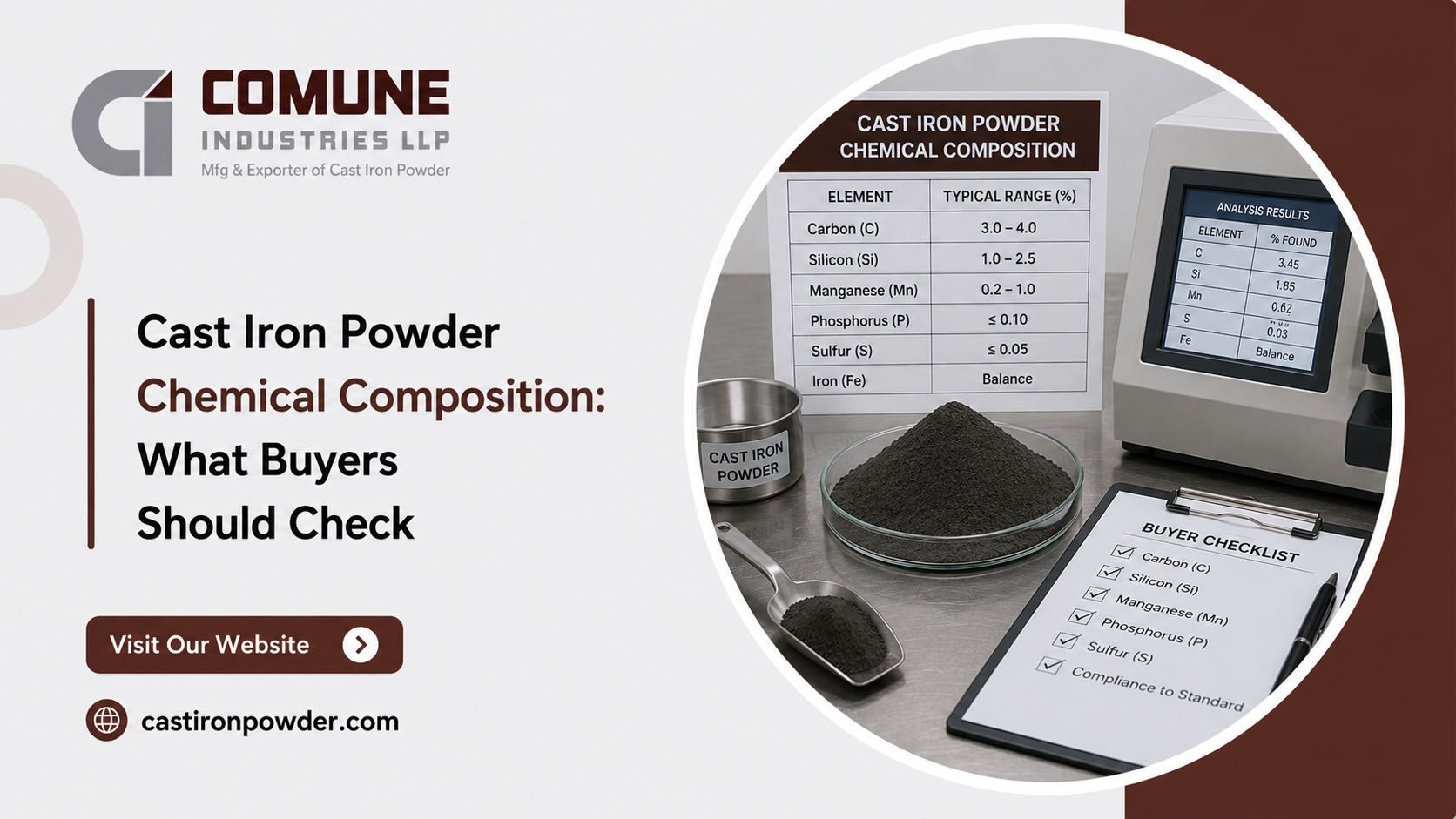
When you're sourcing cast iron powder for automotive parts, friction materials, welding electrodes, or metallurgical applications, the single most important factor to verify isn't the price — it's the cast iron powder chemical composition. Two batches of powder can look identical on paper and still perform very differently once they reach your production line, simply because their elemental makeup doesn't match your specification.
Powders made from different raw materials, grades, or manufacturing processes can carry noticeably different compositions, even when they're marketed under the same general name. That composition, in turn, has a direct impact on how the powder behaves during processing, how consistent it is from batch to batch, and how well the finished product performs in its intended application. In this guide, we'll walk through the key elements buyers should check, how chemical analysis is carried out, what purity really means, and the quality standards worth confirming before you place a bulk order.
What Is Cast Iron Powder Chemical Composition?
In simple terms, chemical composition refers to the percentage breakdown of the different elements present in a powder — how much iron, carbon, silicon, manganese, sulfur, phosphorus, and other trace elements make up each batch.
Cast iron powder is not a single, uniform substance. It's made up of a dominant iron content along with a set of alloying and residual elements that shape its properties. Understanding cast iron powder composition means being able to separate the "main" element (iron) from the smaller — but equally important — elements that influence hardness, compressibility, flow behaviour, and reactivity.
For buyers, the practical takeaway is this: composition should always be compared against your required product specification, not assumed from the product name or general category alone. A powder described as "cast iron powder" can still fall outside your tolerance range on one or two elements, which is why checking the actual test data matters more than checking the label.
Why Chemical Composition Matters to Buyers
- Product consistency – Composition determines whether every bag or drum performs the same way.
- Application performance – Elements like carbon and silicon directly affect how the powder behaves in your process, whether that's sintering, friction material production, or welding.
- Processing behaviour – Composition can influence compressibility, flow, and reaction with other materials.
- Quality control – A documented composition gives your QC team something concrete to measure against.
- Batch-to-batch consistency – Repeated testing across batches helps confirm the supplier's process is stable over time.
Key Elements Found in Cast Iron Powder
Before comparing suppliers, it helps to understand what each major element contributes and why it's worth reviewing individually rather than looking at the powder as a single homogeneous product.
Iron (Fe) Content
Iron is, unsurprisingly, the primary component of cast iron powder, and it's usually the first figure buyers look at. But a high iron percentage on its own doesn't guarantee suitability — it simply confirms the base material. Buyers should always check the specified iron percentage against their application requirement, since even small variations can shift the balance of the remaining alloying elements and affect downstream performance.
Carbon (C) Content
Carbon plays a defining role in cast iron powder, influencing hardness, machinability, and metallurgical behaviour. Carbon levels can vary noticeably depending on the grade and the manufacturing route used to produce the powder. Because of this, it's important to check the carbon range stated in the specification rather than assuming it will be consistent across every "cast iron powder" product on the market.
Silicon (Si) Content
Silicon influences the structure and processing characteristics of cast iron powder. Different grades are formulated with different silicon levels depending on their intended use, so buyers comparing multiple suppliers or product lines should look closely at how silicon content is specified for each grade rather than treating it as a minor detail.
Manganese (Mn) Content
Manganese contributes to the metallurgical properties of the powder and, like silicon, tends to vary by grade. As with the other elements, the manganese level quoted by a supplier should match — or fall within tolerance of — the specification your application calls for.
Sulfur (S) and Phosphorus (P)
Sulfur and phosphorus are commonly monitored because, in most applications, elevated levels are undesirable. These elements are typically controlled to a maximum permitted percentage rather than a target range, so buyers should specifically check that reported sulfur and phosphorus figures stay within the agreed ceiling for their application.
Other Trace Elements
Depending on the grade and production process, some cast iron powders may also contain additional trace elements. Rather than focusing only on iron content, buyers should request and review the complete elemental specification, since an unreported trace element can sometimes be just as relevant to end-use performance as the primary alloying elements.
Understanding Cast Iron Powder Composition by Grade
Not every cast iron powder shares an identical chemical makeup. Grade and intended application both influence how a specification is written, which means the same general product category can cover a range of compositions depending on what it's designed to do.
Before purchasing, buyers should first identify the specific grade required for their application — whether that's for a particular mesh size, friction application, or metallurgical process — and then compare the supplier's documented specification for that grade against their own application requirements. Comune Industries manufactures cast iron powder across several particle size ranges and grades, so confirming the correct grade upfront helps avoid mismatches later in the process.
Why Grade-Specific Composition Matters
- Different manufacturing requirements – Some processes need tighter tolerances on specific elements.
- Different physical and chemical properties – Grades are formulated to deliver particular hardness, flow, or reactivity characteristics.
- Application-specific performance – A composition that works well in one use case may not suit another.
- Consistent production results – Matching grade to application reduces the risk of unexpected variation in your own process.
How Is Cast Iron Powder Chemical Analysis Performed?
Understanding, at a high level, how cast iron powder chemical analysis is carried out helps buyers ask better questions and interpret supplier documentation with more confidence.
Sample Collection
Accurate analysis starts with a representative sample. If the sample doesn't reflect the true composition of the bulk batch, the resulting test data won't either. Buyers should ask suppliers how sampling is carried out and take steps to avoid contamination when handling samples themselves.
Laboratory Testing
Chemical composition is evaluated using appropriate laboratory analytical methods, and testing should be carried out according to the relevant specification or testing standard for the product. The exact method used can vary by supplier and by element, so it's reasonable for buyers to ask which methods are applied.
Reviewing the Test Results
Once results are available, they should be compared directly against the specified limits for each element — not just skimmed for a general impression. It's also worth double-checking the units and reporting format, since inconsistent units can make results look better or worse than they actually are. Reviewing all relevant elements, rather than focusing solely on iron, gives a far more complete picture of whether a batch meets your requirements.
How to Check Cast Iron Powder Purity Before Buying
What Does Purity Mean in Cast Iron Powder?
Cast iron powder purity is best understood in the context of the product specification rather than as an abstract concept. A powder isn't simply "pure" or "impure" — it either conforms to the agreed chemical specification or it doesn't. It's worth distinguishing between a high iron content and overall chemical conformity: a powder can show a strong iron percentage while still falling outside tolerance on another element.
Check for Unwanted Elements and Impurities
Buyers should identify any elements that fall outside the agreed specification, consider the contamination risks associated with the supplier's handling and storage processes, and factor in consistency across batches — a single good test result doesn't guarantee the next shipment will match.
Request a Certificate of Analysis
A Certificate of Analysis (CoA) is a document that reports the actual tested composition of a specific batch. When requesting one, buyers should look for batch-specific data (not a generic average), the full list of tested elements, the testing date, and clear unit labelling. Batch-specific documentation is particularly useful because it allows you to track consistency across multiple orders over time.
Cast Iron Powder Quality Standards Buyers Should Know
Understanding cast iron powder quality standards matters because specifications aren't universal — they vary according to product type, application, target market, and individual buyer requirements. There isn't a single standard that applies uniformly to every cast iron powder product, which is why buyers should always confirm which standard or specification applies to their specific purchase before assuming compliance.
What Should a Quality Specification Include?
A complete specification typically documents:
- Chemical composition
- Grade
- Particle size
- Moisture content
- Bulk density, where applicable
- Other application-specific properties
- Acceptable tolerances for each parameter
You can review how Comune Industries approaches quality and production standards for more context on what a documented specification generally covers.
What Buyers Should Check in a Cast Iron Powder Test Report
Use this table as a practical, at-a-glance checklist when reviewing a supplier's test report:
|
Parameter |
What Buyers Should Check |
|
Iron (Fe) |
Specified iron content |
|
Carbon (C) |
Required carbon range |
|
Silicon (Si) |
Stated specification |
|
Manganese (Mn) |
Acceptable range |
|
Sulfur (S) |
Maximum permitted level |
|
Phosphorus (P) |
Maximum permitted level |
|
Trace elements |
Any application-specific requirements |
|
Grade |
Correct product grade |
|
Batch number |
Match with supplied material |
|
Test date |
Recent, batch-specific information |
Common Chemical Quality Problems Buyers Should Watch For
Even experienced buyers can run into avoidable issues if these red flags go unchecked:
- Composition falling outside the agreed specification
- Unexplained batch-to-batch variation
- Excessive unwanted elements beyond agreed limits
- Missing chemical test documentation
- A mismatch between the sample tested and the bulk material delivered
- Incomplete supplier specifications that omit key elements
- Inconsistent reporting formats or units between batches
Catching these issues early — ideally before a bulk order is confirmed — saves significant time and cost compared to discovering them once material reaches your production floor.
How to Compare Cast Iron Powder Suppliers
When evaluating suppliers, it helps to look beyond price and compare on quality fundamentals instead.
Compare Product Specifications
Look closely at chemical composition, grade, particle size, and other physical properties side by side, rather than relying on marketing descriptions.
Review Quality Documentation
Ask for a Certificate of Analysis, Technical Data Sheet, batch information, and any relevant testing documentation before committing to an order.
Evaluate Batch Consistency
Where possible, compare results across multiple batches to see whether the supplier's material consistently falls within the agreed specification, rather than judging quality from a single data point.
Request a Sample Before Bulk Purchase
Testing a sample first lets you confirm it meets your requirements and lets you and the supplier establish clear specifications before a bulk order is approved. Comune Industries offers afree sample so buyers can verify composition and performance before committing to volume.
Chemical Composition vs Physical Properties: What's the Difference?
Chemical composition alone doesn't provide a complete picture of powder quality. Physical properties matter just as much for how the powder actually behaves in your process.
|
Chemical Properties |
Physical Properties |
|
Iron content |
Particle size |
|
Carbon content |
Mesh distribution |
|
Silicon content |
Bulk density |
|
Manganese content |
Flowability |
|
Sulfur/phosphorus |
Moisture |
|
Other elements |
Particle shape |
Buyers should evaluate both chemical and physical specifications together, based on the specific demands of their application, rather than assuming that strong chemical test results automatically translate into good physical performance. You can browse the available particle sizes and grades to see how physical specifications are presented alongside product options.
Conclusion
Cast iron powder chemical composition isn't a detail to skim past — it's one of the most reliable indicators of whether a product will actually meet your application's requirements. Checking iron, carbon, silicon, manganese, sulfur, and phosphorus levels, understanding how chemical analysis and purity are verified, and confirming the relevant quality standards all give buyers a much clearer basis for comparison than price or packaging alone.
The most reliable approach is to review the complete composition rather than focusing only on iron content, ask for proper documentation — including batch-specific Certificates of Analysis — and confirm batch-to-batch consistency before scaling up to bulk orders. Comparing supplier specifications against your own application requirements before purchase is, ultimately, the step that prevents most quality issues down the line.
If you're evaluating suppliers for your next order, Comune Industries manufactures cast iron powder across multiple grades and particle sizes in Ahmedabad, India, and can share composition and specification details for the grade that fits your application. Request a free sample or get in touch with our team to discuss your requirements.