
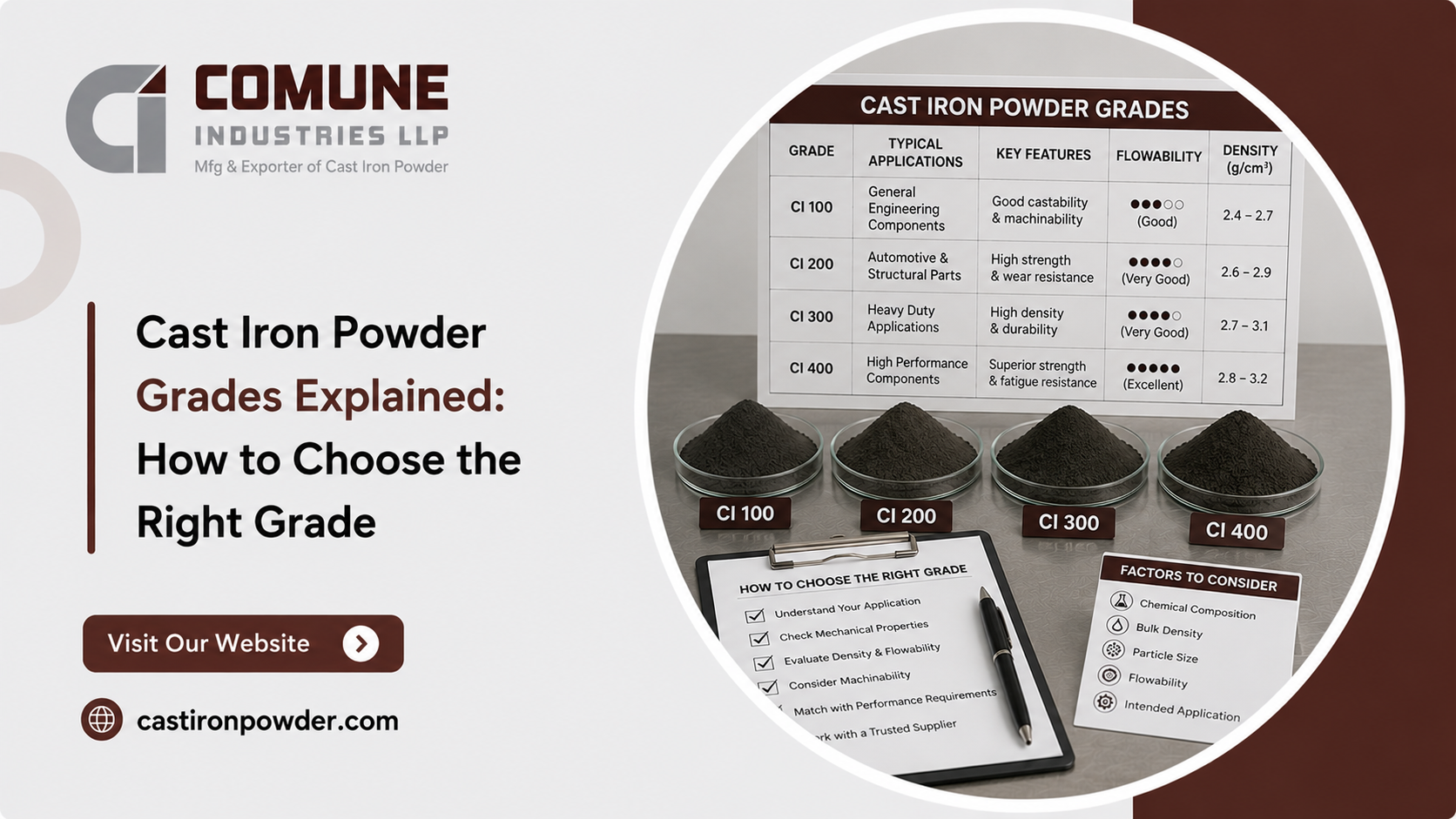
Cast iron powder is used across a wide range of industrial processes, from powder metallurgy and friction materials to welding, brazing, and chemical applications. But not all cast iron powder is the same. Manufacturers produce it in different cast iron powder grades, each suited to a particular particle size range, application, and performance requirement. Choosing the wrong grade can affect flowability, packing behaviour, and the final performance of your finished product.
This guide breaks down the different types of cast iron powder, explains how each cast iron powder grade is classified, and walks you through how to choose cast iron powder that matches your process requirements. We'll also cover the cast iron powder specifications buyers should check before placing a bulk order.
What Are Cast Iron Powder Grades?
A cast iron powder grade generally refers to the particle size classification of the powder, usually expressed in mesh size. Mesh size indicates how many openings per linear inch a sieve has — the higher the mesh number, the finer the powder particles that pass through it.
Grading matters because particle size directly influences how a powder behaves during handling, mixing, compacting, and sintering. A grade suited for one application, such as friction linings, may not perform well in another, such as welding flux or chemical processing.
Manufacturers typically classify cast iron powder grades into ranges rather than single fixed sizes, since a controlled distribution of particle sizes is what gives a powder its predictable, repeatable behaviour in production.
Why Grading Matters in Industrial Applications
- Consistency – A defined grade ensures every batch behaves the same way in your process.
- Compatibility – Certain equipment (feeders, dies, mixers) is calibrated to work with specific particle size ranges.
- Performance – Particle size affects density, flow, and how particles bond or compact under pressure.
- Cost efficiency – Using the correct grade reduces material waste and rework caused by processing issues.
Common Types of Cast Iron Powder by Mesh Size
Cast iron powder is generally supplied across five standard mesh ranges, moving from coarser to finer particle sizes.
Cast Iron Powder 10 to 30 Mesh
This is a coarser grade, made up of comparatively larger particles. It is commonly used in applications where a coarser, free-flowing material is preferred, such as certain foundry and general industrial uses where fine powder isn't necessary.
Cast Iron Powder 30 to 60 Mesh
A mid-coarse grade that balances flow characteristics with a moderate particle size. This range is often selected for processes that need a manageable, consistent feed without the finer characteristics of higher-mesh powders.
Cast Iron Powder 60 to 100 Mesh
This intermediate grade is finer than the 30–60 mesh range and is used where a tighter particle size distribution is needed for more controlled processing, such as certain friction material and compacting applications.
Cast Iron Powder -100 Mesh
A finer grade where all particles pass through a 100-mesh sieve. Finer powders like this tend to have a larger surface area relative to their volume, which can influence packing density, reactivity, and how the powder behaves during compaction.
Cast Iron Powder -120 Mesh
This is the finest standard grade, with particles passing through a 120-mesh sieve. Very fine grades like this are typically chosen for applications that need maximum surface contact, uniform distribution, or precise dosing.
See the full range of Cast Iron Powder Grades from Comune Industries →
Other Ways Cast Iron Powder Is Classified
While mesh size is the most common classification for cast iron powder grades, powders may also be described by other characteristics that affect grade selection.
By Production Method
- Reduced iron powder – produced through reduction processes, generally offering high purity and controlled particle characteristics. Learn more about our reduction grade iron powder.
- Atomized iron powder – produced by atomizing molten metal, often resulting in more spherical particles.
By Colour and Composition
- Black iron powder – a widely used variant known for its consistent particle size and uniform distribution, commonly used in magnets and friction materials. See our black iron powder range.
- Pure/high-purity iron powder – used where chemical consistency is critical, such as in powder metallurgy and additive manufacturing. Explore our iron metal powder offering.
Understanding both the mesh-based grade and the production/composition type together gives a fuller picture of which cast iron powder grade is right for a given application.
How to Choose Cast Iron Powder: Step-by-Step
Selecting the correct grade isn't just about picking a mesh size — it's about matching the powder's characteristics to your process. Here's how to approach it.
Step 1 – Define Your Application Requirements
Start by identifying what the powder needs to do in your process. Are you compacting it into components, using it as a friction material, blending it into a mixture, or using it in a chemical reaction? Each use case has a preferred particle size range and purity level.
Step 2 – Identify the Required Particle Size Range
Once your application is clear, narrow down the appropriate mesh range. Coarser grades (10–30, 30–60 mesh) generally suit applications needing free-flowing, less compact material, while finer grades (-100, -120 mesh) suit applications requiring dense packing, uniform distribution, or fine surface finish.
Step 3 – Check Chemical Composition and Purity
Beyond particle size, confirm the chemical composition matches your specification — carbon content, trace elements, and purity levels can all affect how the powder performs in your process.
Step 4 – Review Physical Properties
Look at bulk density, flowability, and moisture content alongside the grade. Two powders in the same mesh range can still behave differently if these properties vary.
Step 5 – Request Samples and Test Reports
Before committing to a bulk order, request a sample and the accompanying test report. This lets you validate that the grade performs as expected in your actual process, not just on paper.
Step 6 – Confirm Consistency Across Batches
Ask your supplier how they maintain batch-to-batch consistency. A grade is only useful if it performs the same way every time you reorder.
Cast Iron Powder Specifications: What Buyers Should Check
When evaluating cast iron powder specifications, buyers should look beyond the mesh size alone. A complete specification typically includes:
|
Specification |
Why It Matters |
|
Grade/mesh size |
Determines particle size range and suitability for the application |
|
Chemical composition |
Confirms material grade and consistency |
|
Bulk density |
Affects handling, storage, and volume calculations |
|
Particle size distribution |
Impacts packing behaviour and process consistency |
|
Moisture content |
Influences handling, storage, and reactivity |
|
Flowability |
Important for feeding and dosing in automated processes |
|
Testing method |
Ensures results are comparable and repeatable |
|
Batch/lot information |
Enables traceability and consistency checks |
Having this information documented — ideally in a formal test report — helps buyers compare suppliers on a like-for-like basis rather than relying on mesh size alone.
Matching Cast Iron Powder Grades to Applications
While exact requirements vary by process and specification, here's a general sense of how different grades are commonly matched to applications:
- Coarser grades (10–30, 30–60 mesh): general industrial use, applications where free flow and larger particle size are preferred.
- Mid-range grades (60–100 mesh): friction materials, compacting applications requiring a controlled particle size.
- Finer grades (-100, -120 mesh): applications requiring dense packing, uniform distribution, or fine surface characteristics, such as certain powder metallurgy and specialty uses.
Always confirm the exact grade requirement with your process engineer or the relevant industry specification before finalising an order, since application requirements can vary significantly even within the same industry.
Common Mistakes When Selecting a Cast Iron Powder Grade
- Choosing a grade based on mesh size alone, without checking chemical composition or physical properties.
- Assuming all suppliers test and classify grades using the same method.
- Overlooking batch-to-batch consistency when scaling from sample to bulk order.
- Not requesting a test report or specification sheet before purchase.
- Ignoring how moisture content or bulk density can affect performance within a given grade.
- Failing to match the grade to the actual process requirement, rather than what's simply available.
Conclusion
Choosing the right cast iron powder grade comes down to understanding your application's requirements and matching them against particle size, chemical composition, and physical properties — not mesh size alone. Reviewing detailed cast iron powder specifications, requesting samples, and confirming batch consistency will help you avoid costly mismatches between the material and your process.
At Comune Industries, we manufacture cast iron powder across all standard grades — from 10–30 mesh to -120 mesh — with consistent quality backed by in-house testing. Explore our full range of cast iron powder grades, check our quality standards, or get in touch with our team to find the right grade for your application.