Buying cast iron powder in bulk is a significant commitment. A single poor batch can disrupt production schedules, damage finished components, and cost far more to fix than it would have cost to prevent. That's why cast iron powder quality testing should always happen before you sign off on a large order — not after the truck has already arrived at your warehouse.
The challenge is that powder quality is not something you can judge by looking at it. Two batches can look identical — same grey-black colour, same fine texture — yet behave completely differently once they reach your production line. One may flow smoothly and sinter evenly, while the other clumps, jams equipment, or produces parts that fail specification.
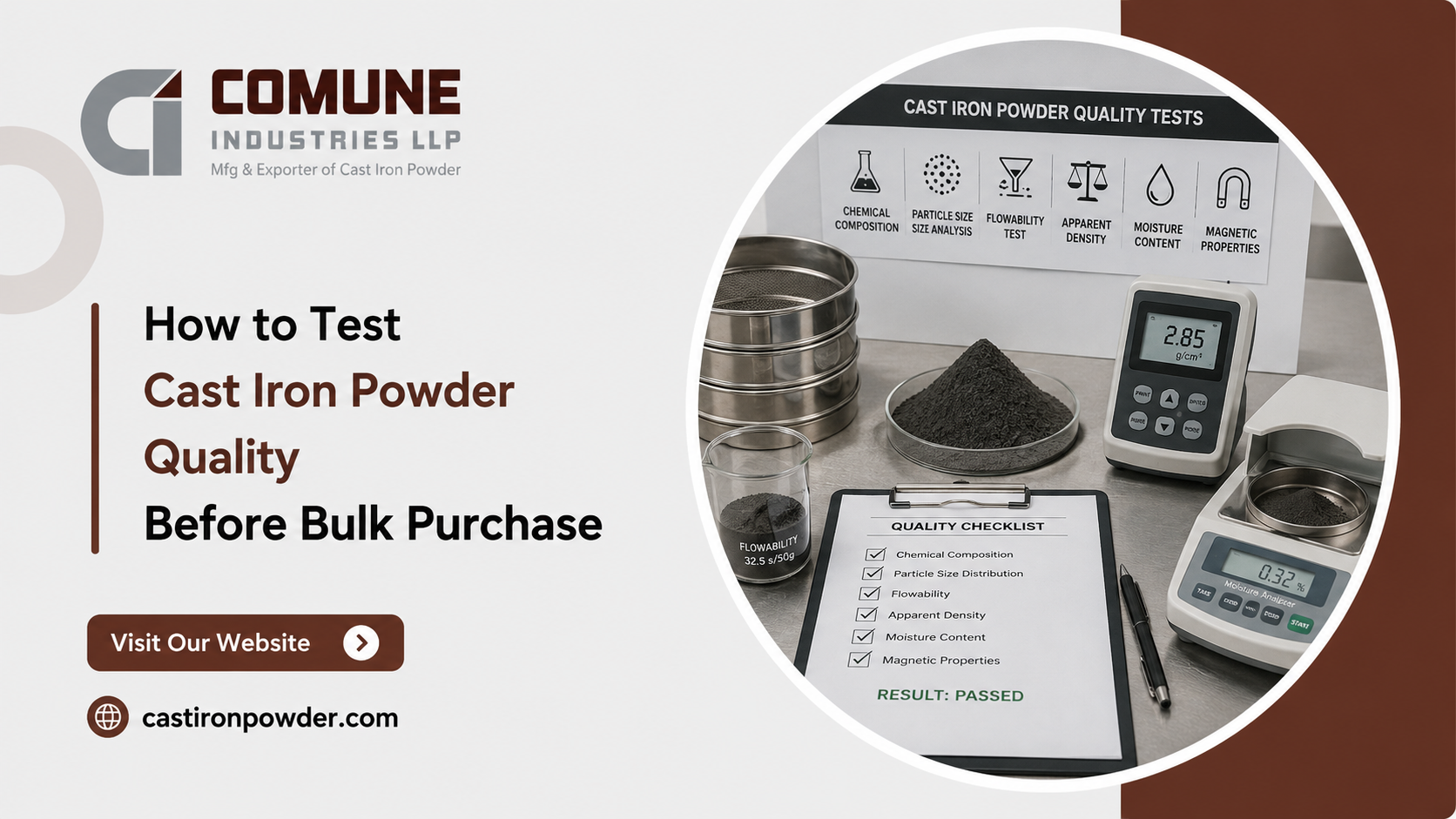
To avoid this, buyers need to look past appearance and evaluate the properties that actually determine performance: chemical composition, particle size, moisture content, bulk density, flowability, and consistency from batch to batch. This guide walks through exactly how to check each of these before you commit to a bulk purchase, what documents to request from your supplier, and the questions worth asking before you place a large order.
Why Quality Testing Matters Before a Bulk Purchase
There's a meaningful difference between accepting a small sample and approving a bulk order. A sample only tells you what one batch, produced under specific conditions, looks like. A bulk order assumes that every subsequent batch will match that same standard — and that assumption needs to be verified, not taken on trust.
Inconsistent powder quality can affect your manufacturing process in several ways. Variations in particle size can change how a part sinters or compacts. Shifts in chemical composition can alter mechanical properties like hardness, strength, and wear resistance. Even small changes in moisture or flowability can cause dosing errors, equipment downtime, or defective output.
This is why quality testing should never be skipped, regardless of how reputable a supplier appears to be. Before committing to a large quantity, buyers should:
- Confirm the powder meets their required specifications, not just general industry norms
- Compare actual test results against the numbers on paper
- Understand how much variation is acceptable for their specific application
Testing before purchase is far cheaper than discovering a problem after a bulk shipment has already been used in production.
Key Properties to Check in Cast Iron Powder
Before evaluating any test method, it helps to understand exactly which properties determine whether a batch of cast iron powder is fit for purpose. These are the core parameters every buyer should check.
Chemical Composition
The elemental makeup of cast iron powder directly determines its mechanical and metallurgical behaviour. At a minimum, buyers should review:
- Iron content — the base material, and the primary indicator of purity
- Carbon content — affects hardness, strength, and how the powder responds to heat treatment
- Silicon — influences fluidity and casting characteristics
- Manganese — affects hardenability and helps control sulfur-related defects
- Sulfur and phosphorus — typically kept low, as excess levels can weaken the final product
- Other trace elements — depending on the specific grade and intended application
Chemical composition should always be checked against the required grade or specification for your application. A powder that's technically "cast iron powder" but falls outside your tolerance range for carbon or silicon can still cause problems downstream, even if every other property looks fine.
Particle Size and Mesh Distribution
Particle size refers to how fine or coarse the individual powder particles are, usually expressed as a mesh size or micron range. This matters because particle size affects how the powder packs, flows, sinters, and bonds during processing.
Consistency is just as important as the target size itself. A batch with a wide, uneven particle-size distribution can behave unpredictably even if the "average" size matches specification. This is why cast iron powder particle size testing through sieve analysis is one of the most important checks a buyer can run before approving a bulk order — different applications, from powder metallurgy to friction materials, often call for very different particle-size ranges, so a size that works well for one use case may be entirely unsuitable for another.
Moisture Content
Excess moisture is one of the more overlooked issues in powder quality, but it can cause real handling problems. Moisture affects how the powder flows through equipment, how it stores over time, and how consistently it can be dosed or measured. High moisture levels also increase the risk of clumping, which can clog feeders and create uneven mixing.
Checking moisture content before accepting a bulk order is a simple step that prevents storage and handling issues later, particularly if the powder will be stored for an extended period before use.
Bulk Density
Bulk density measures how much a given volume of powder weighs, accounting for the air gaps between particles. It might sound like a minor detail, but it has a direct impact on storage planning, transportation costs, dosing accuracy, and how the powder behaves during processing.
A supplier's technical specification will typically list an expected bulk density range. Buyers should test the actual sample against this figure — a significant deviation can indicate inconsistencies in particle shape, size distribution, or processing method.
Flowability
Flowability describes how easily powder moves through hoppers, feeders, and processing equipment. Poor flowability can cause bridging, uneven feeding, and inconsistent dosing, all of which create downstream production problems.
Several factors influence flowability, including particle shape, particle-size distribution, moisture content, and how the powder has been stored. A powder that flows well in a lab sample but poorly at scale is a warning sign worth investigating before a bulk commitment.
Cast Iron Powder Testing Methods
Once you understand which properties matter, the next step is knowing how to actually test them. Here are the practical methods buyers can use — or request from a supplier or independent lab — on a representative sample.
Sieve Analysis
Sieve analysis is the standard method for determining particle-size distribution. A sample is passed through a stack of sieves with progressively finer mesh openings, and the amount of powder retained on each sieve is measured. This produces a clear picture of how particle sizes are distributed across the sample.
Buyers should look for a distribution that matches the agreed specification, with minimal spread outside the target range. Just as importantly, this test should be repeated across different batches to confirm that particle size stays consistent over time, not just in the initial sample.
Chemical Composition Analysis
Laboratory analysis — typically using spectrometry — provides an accurate breakdown of the powder's elemental composition. This is the only reliable way to confirm iron, carbon, silicon, manganese, sulfur, and phosphorus content, since visual inspection cannot reveal chemical makeup.
Results should be compared directly against the required specification for your grade. Laboratory testing removes guesswork and gives buyers objective, verifiable data rather than relying on a supplier's general claims.
Moisture Testing
Moisture testing is usually straightforward, using weight-loss-on-drying methods to determine how much moisture is present in a sample. The results indicate whether the powder is suitable for immediate use and how it's likely to behave in longer-term storage.
Bulk Density Testing
Bulk density is typically measured by filling a container of known volume with powder and weighing the result, following a standardised procedure to keep results consistent and comparable. Buyers should look for results that align closely with supplier specifications, since consistency here matters as much as the number itself.
Flowability Testing
Flow characteristics can be assessed through methods such as flow-rate testing or angle-of-repose measurement, both of which indicate how freely the powder moves under controlled conditions. Since flowability directly affects how smoothly a bulk order will perform on your production line, it's worth evaluating before — not after — a large purchase is finalised.
How to Perform a Cast Iron Powder Quality Check Before Ordering
Bringing all of this together, here's a simple, practical process buyers can follow to run a thorough cast iron powder quality check before approving a bulk order.
- Define your required specifications — Set clear targets for composition, particle size, moisture, and other properties based on your application.
- Request a representative sample — Ask for a sample that reflects the actual batch or production run you'd be ordering from, not a curated "showcase" sample.
- Review the supplier's technical specification — Compare their stated properties against your requirements before testing begins.
- Test chemical composition — Confirm iron, carbon, silicon, manganese, sulfur, and phosphorus levels match your grade.
- Check particle size and mesh distribution — Run sieve analysis to confirm the size range and consistency.
- Check moisture and bulk density — Verify both fall within acceptable limits for your process.
- Evaluate flowability — Test how the powder behaves under handling conditions similar to your production setup.
- Compare results with the agreed specifications — Look for any deviations, however small, and assess whether they're within acceptable tolerance.
- Review batch documentation — Check that the sample's paperwork matches what would accompany the actual bulk shipment.
- Approve the bulk order only after the sample meets requirements — Don't move forward until every relevant property has been verified.
What Documents Should You Request From a Cast Iron Powder Supplier?
Testing a physical sample is essential, but paperwork matters too. Reputable suppliers should be able to provide the following documentation for review.
Certificate of Analysis (CoA)
A Certificate of Analysis is a batch-specific document that confirms the actual test results for that production run. It typically includes:
- Chemical composition results for that specific batch
- Physical properties such as particle size and bulk density
- Batch or lot identification information
Buyers should review the CoA carefully before ordering, and ideally request one for the exact batch being shipped, rather than a generic reference document.
Technical Data Sheet (TDS)
A Technical Data Sheet outlines the general specifications for a product line, including:
- Product specifications and grade classification
- Particle size range
- Physical and chemical property ranges
- Recommended applications
The TDS gives buyers a baseline understanding of what to expect, while the CoA confirms what a specific batch actually delivers. You can review Comune Industries' product range and quality standards to see how this information is typically presented.
Sample Test Report
If you've had an independent lab test a sample, that report becomes a useful point of comparison against the supplier's own stated specifications. Any significant gap between the two is worth discussing with the supplier before finalising a bulk order.
How to Identify Low-Quality Cast Iron Powder
Even without full lab access, there are warning signs that can indicate a supplier's powder may not hold up to bulk-scale use:
- Inconsistent particle size within the same sample
- Excessive moisture or visible clumping
- Unexplained changes in colour or appearance between samples
- Poor flowability during basic handling
- Inconsistent chemical composition across supposedly identical batches
- Missing, vague, or unclear test documentation
- Noticeably different results between batches from the same supplier
- Reluctance or refusal to provide samples or specifications on request
Any one of these on its own may not be disqualifying, but a supplier showing several of these signs deserves closer scrutiny before you place a bulk order.
Why Sample Testing Is Important Before Bulk Purchase
Product descriptions and marketing pages can tell you what a powder is supposed to be — they can't confirm what a specific batch actually is. That's why sample testing matters so much:
- Never rely solely on product descriptions or general grade claims
- Always test a representative sample from the batch you intend to order
- Confirm the sample genuinely meets your application's requirements, not just general industry standards
- Check consistency across more than one sample if possible, before approving a large order
- Discuss acceptable tolerances with your supplier upfront, so both sides agree on what "within specification" actually means
Questions to Ask a Cast Iron Powder Supplier Before Bulk Ordering
Before placing a bulk order, it's worth working through a short checklist of questions with your supplier:
- What grade of cast iron powder do you supply?
- What particle sizes or mesh sizes are available?
- Can you provide a Certificate of Analysis?
- What is the typical chemical composition for this grade?
- How do you control moisture during production and storage?
- How do you maintain batch-to-batch consistency?
- Can you provide a product sample before I commit to a bulk quantity?
- What quality testing methods do you use internally?
- What are your minimum bulk order quantities?
- Can you provide test reports for the specific batch I'll be receiving?
A supplier who answers these clearly and provides supporting documentation is generally a stronger, more transparent partner for a long-term bulk relationship.
Common Mistakes Buyers Should Avoid
Even experienced buyers can fall into a few avoidable traps when sourcing cast iron powder in bulk:
- Choosing a supplier based on price alone
- Skipping sample testing to save time
- Not checking particle size before ordering
- Ignoring chemical composition in favour of general product claims
- Not reviewing the Certificate of Analysis before approval
- Assuming all cast iron powder is essentially the same
- Failing to define clear specifications before requesting quotes
- Not checking whether batch-to-batch consistency has been verified
Avoiding these mistakes usually comes down to one habit: testing and documentation before commitment, every time — regardless of how long you've worked with a supplier.
How to Choose a Reliable Cast Iron Powder Supplier
Beyond individual batch testing, it's worth evaluating suppliers on a few objective, ongoing factors:
- Consistent product specifications across orders
- Documented quality control procedures
- In-house or third-party testing facilities
- Batch traceability and record-keeping
- Clear, accessible technical documentation
- Willingness to provide samples before bulk commitment
- Sufficient production capacity for your order volumes
- A track record in bulk supply, not just small-scale orders
- Ability to consistently meet your required particle size and composition
These factors matter more than marketing claims. A supplier that can demonstrate consistent quality control, manufacturing capability, and transparent documentation is generally a safer long-term partner for bulk procurement.
Final Quality Checklist Before Bulk Purchase
|
Quality Parameter |
What to Check |
|
Chemical composition |
Required elemental composition (iron, carbon, silicon, manganese, sulfur, phosphorus) |
|
Particle size |
Mesh size and particle-size distribution |
|
Moisture |
Moisture level within specification |
|
Bulk density |
Consistent density matching supplier's stated range |
|
Flowability |
Suitable flow characteristics for your process |
|
Appearance |
Consistent colour and physical condition |
|
CoA |
Batch-specific test results provided and reviewed |
|
Sample |
Sample meets all agreed specifications |
|
Batch consistency |
Results remain within required limits across batches |
Conclusion
Cast iron powder quality testing should always happen before a bulk order is approved, not after it's delivered. The most important checks — chemical composition, particle size, moisture, bulk density, flowability, and supporting documentation — together give buyers a complete, reliable picture of what they're actually purchasing.
Before committing to a large quantity, take the time to establish clear specifications, request a representative sample, and verify that the results genuinely match what your application requires. This one step can save significant time, cost, and production headaches down the line.
If you're looking for a consistent, well-documented supply of cast iron powder for your bulk requirements, Comune Industries offers detailed technical documentation and sample-based verification before every bulk order. Request a free sample or get in touch with our team to discuss your specification requirements.