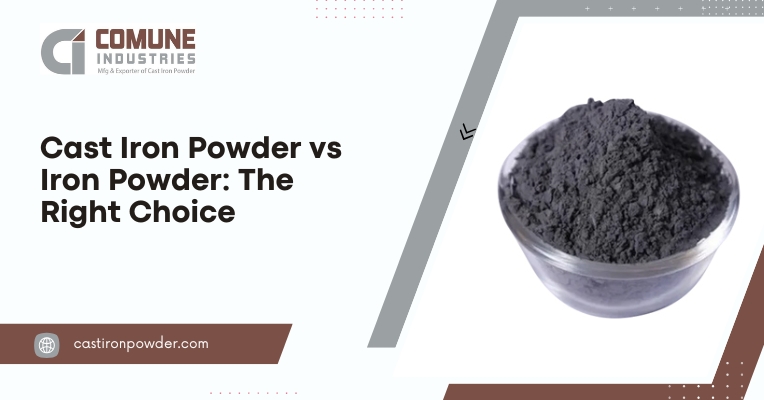
Choosing the right metal powder is not just a technical decision. It directly affects product quality, production cost, and long-term performance. Many industries struggle to decide between cast iron powder and iron powder because both materials look similar but perform very differently.
As a trusted cast iron powder manufacturer and iron powder manufacturer, COMUNE INDUSTRIES helps businesses choose the right powder based on application needs, not assumptions. In this guide, we explain the differences in simple terms so you can make the right choice with confidence.
Why Choosing the Right Metal Powder Matters
Metal powders play a vital role in manufacturing, automotive, engineering, and chemical industries. Even small changes in composition or particle size can impact final results.
If the wrong powder is selected, it may lead to:
- Reduced product life
- Higher wear and tear
- Increased rejection rates
- Unnecessary production costs
That is why working with a reliable Iron Powder Supplier or an experienced cast iron powder manufacturer in India makes a real difference.
What Is Cast Iron Powder?
Cast iron powder is produced from cast iron using controlled crushing or atomization methods. It contains a higher carbon percentage, which gives it unique physical and mechanical properties.
As a professional cast iron powder manufacturer, Comune Industries maintains a stable composition and consistent particle size to ensure reliable performance across batches.
Key Properties of Cast Iron Powder
- Higher carbon content
The increased carbon level improves wear resistance and makes the material suitable for heavy-duty use. - Excellent wear resistance
It performs well in applications exposed to continuous friction and surface stress. - Good thermal stability
Cast iron powder remains stable under high temperatures without losing performance. - Strong vibration damping
The material absorbs vibrations effectively, helping reduce noise and mechanical stress. - Cost-effective for bulk applications
It offers reliable performance at a lower cost for large-scale industrial use.
These properties make cast iron powder suitable for friction-based and wear-resistant applications.
What Is Iron Powder?
Iron powder is manufactured from high-purity iron through reduction or atomization processes. It has very low carbon content and high chemical purity, making it suitable for precision-driven industries.
A reliable iron powder manufacturer focuses on purity, flowability, and uniform particle structure. Comune Industries also works as a dependable Iron Powder Supplier for various industrial requirements.
Key Properties of Iron Powder
- High iron purity
High purity ensures consistent mechanical and chemical performance. - Low carbon and oxygen levels
Minimal impurities help improve strength and reliability after processing. - Excellent compressibility
Iron powder compacts well, making it ideal for powder metallurgy applications. - Strong performance after sintering
It delivers high strength and stability once sintered. - Consistent and predictable behavior
Uniform properties make it easier to control during manufacturing.
Iron powder is best suited for applications where accuracy and strength are critical.
Cast Iron Powder vs Iron Powder: Key Differences Explained
Although both materials are iron-based, their behavior differs due to composition and processing methods.
1. Chemical Composition
Cast iron powder contains a higher carbon level, usually above 2 percent.
Iron powder contains very low carbon, typically below 0.05 percent.
This difference affects wear resistance, machinability, and overall strength.
2. Mechanical Performance
Cast iron powder offers:
- Better resistance to wear and surface damage
- Improved friction control in moving parts
- High vibration absorption for smoother operation
Iron powder offers:
- Better ductility and flexibility
- Higher strength after sintering
- Cleaner and more uniform metallurgical structure
The right choice depends on how the final product will be used.
3. Cost Considerations
Cast iron powder is generally more economical for large-scale production.
Iron powder costs more due to higher purity standards and strict process control.
For non-precision applications, cast iron powder can significantly reduce costs.
4. Processing Behavior
Iron powder performs better in powder metallurgy and sintering processes.
Cast iron powder works well in friction materials and coating applications.
An experienced iron powder manufacturer can help select the right material.
Manufacturing Process Differences
Understanding how each powder is produced helps buyers make informed decisions.
How Cast Iron Powder Is Made
Cast iron powder is produced by crushing or atomizing solid cast iron. The process focuses on maintaining carbon levels while achieving the required particle size.
A professional cast iron powder manufacturer in India ensures:
- Stable carbon consistency
- Uniform particle distribution
- Reliable metallurgical properties
This process makes cast iron powder suitable for wear-resistant applications.
How Iron Powder Is Made
Iron powder is produced using reduction or atomization techniques. These methods remove impurities and improve overall purity.
A reliable iron powder manufacturer ensures:
- High iron content
- Low impurity levels
- Good flowability and compressibility
This makes iron powder ideal for precision components.
Applications of Cast Iron Powder
Cast iron powder is preferred where durability and friction control matter more than tensile strength.
Common Applications
- Brake pads and clutch facings
- Friction materials
- Thermal spray coatings
- Foundry additives
- Metallurgical processes
Industries often choose a dependable cast iron powder manufacturer for consistent quality.
Applications of Iron Powder
Iron powder is widely used in applications requiring high purity and strength.
Common Applications
- Powder metallurgy parts
- Sintered automotive components
- Welding electrodes
- Chemical processing
- Magnetic materials
A trusted Iron Powder Supplier ensures quality and consistency.
Particle Size and Its Role in Performance
Particle size directly affects flowability, bonding, and surface coverage.
Why Particle Size Matters
- Fine particles improve surface finish and coverage
- Coarse particles improve flowability during processing.
- Balanced sizes ensure stable and efficient manufacturing.
- Comune Industries offers multiple grades to suit different application needs.
Storage and Handling Best Practices
Proper storage helps maintain powder quality and performance over time.
Storage Guidelines
- Store in dry, moisture-free areas
- Use sealed containers
- Avoid prolonged exposure to the air.
- Follow FIFO inventory practices.
A professional Iron Powder Supplier always provides guidance on handling.
Common Buyer Mistakes to Avoid
Many buyers focus only on price and overlook technical requirements.
Common Mistakes
- Choosing iron powder when cast iron powder is sufficient
- Ignoring carbon content requirements
- Not checking batch consistenc..y
- Purchasing from unverified suppliers
Working with an experienced cast iron powder manufacturer in India reduces these risks.
Quality Control and Industry Standards
Metal powders must meet strict quality standards to ensure consistent results.
Comune Industries follows:
- Chemical composition testing
- Particle size analysis
- Batch-wise quality inspection
This ensures reliable performance across all applications.
Why Choose COMUNE INDUSTRIES?
Comune Industries is a trusted name as both a cast iron powder manufacturer and an iron powder manufacturer. We focus on long-term value, not just supply.
What Sets Us Apart
- Advanced manufacturing facilities
- Custom grade solutions
- Technical application support
- Reliable delivery schedules
As a leading Iron Powder Supplier, we serve industries across India and beyond.
Future Trends in Metal Powder Usage
Metal powder demand continues to grow due to modern manufacturing needs.
Key Trends
- Increased use of powder metallurgy
- Rising demand for customized particle sizes
- Higher quality expectations
- Growth in the automotive and engineering sectors
Choosing the right manufacturer ensures a future-ready supply.
Conclusion:
Cast iron powder and iron powder are both valuable materials, but they serve different purposes. Choosing the right one improves efficiency, reduces cost, and ensures long-term performance.
As a reliable cast iron powder manufacturer and iron powder manufacturer, comune industrieshelps you select the right powder for your application.
Contact Comune Industries today to discuss your requirements and get expert guidance.