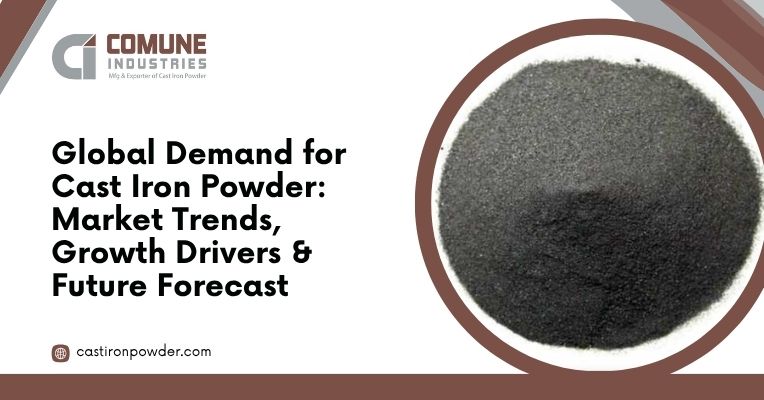
The global manufacturing and industrial sectors are undergoing a rapid transformation driven by efficiency, sustainability, and advanced material engineering. Among the materials gaining significant attention is cast iron powder, a key component in modern powder metallurgy and precision manufacturing.
The cast iron powder market is expanding steadily as industries shift toward cost-effective, high-performance materials. From automotive components to heavy machinery and friction materials, cast iron powder is becoming an essential input across multiple sectors.
In this blog, we explore the global demand trends, key growth drivers, applications, and future outlook of this evolving market.
Understanding Cast Iron Powder and Its Industrial Importance
Cast iron powder is produced by atomizing molten cast iron or by mechanical grinding processes. It retains the core properties of cast iron—such as high wear resistance, excellent compressive strength, and good machinability—while offering flexibility in powder-based manufacturing processes.
It is widely used in:
- Powder metallurgy components
- Automotive brake pads and clutch plates
- Magnetic materials
- Welding and surface coating applications
- Heavy-duty industrial parts
The growing relevance of iron powder applications in industry has significantly increased its adoption in both developed and emerging economies.
Global Cast Iron Powder Demand: Market Overview
The global cast iron powder demand is witnessing steady growth due to the expansion of manufacturing industries and increased adoption of powder metallurgy techniques.
Several macroeconomic factors are contributing to this rise:
- Growth in automotive production and EV components
- Rising demand for durable industrial machinery
- Increased focus on energy-efficient manufacturing
- Expansion of infrastructure and construction activities
Developing countries in Asia-Pacific, particularly India and China, are becoming major consumption hubs due to rapid industrialization and cost-effective production capabilities.
Key Cast Iron Powder Market Trends
The cast iron powder market trends indicate a shift toward advanced material engineering and sustainable production methods. Some of the most notable trends include:
1. Rising Adoption in Automotive Sector
Automotive manufacturers are increasingly using cast iron powder in brake systems, gears, and engine components due to its durability and cost efficiency.
2. Growth in Powder Metallurgy Technologies
The powder metallurgy materials market is expanding, with cast iron powder playing a crucial role in producing complex, near-net-shape components with minimal waste.
3. Shift Toward Sustainable Manufacturing
Industries are moving toward low-waste and energy-efficient production processes. Powder-based manufacturing significantly reduces material loss, making it environmentally favorable.
4. Increasing Use in Friction Materials
Cast iron powder is widely used in brake linings and clutch systems due to its excellent frictional properties and thermal stability.
5. Technological Advancements in Production
Improved atomization and milling techniques are enhancing the quality and consistency of cast iron powders, making them suitable for high-performance applications.
Major Growth Drivers of the Cast Iron Powder Market
The cast iron powder market is driven by several strong growth factors:
1. Expanding Automotive Industry
The global automotive industry remains the largest consumer of cast iron powder. With the rise of electric vehicles and hybrid technologies, demand for lightweight yet durable components is increasing.
2. Industrial Machinery Expansion
Heavy machinery and equipment manufacturers rely on cast iron powder for producing wear-resistant components that enhance operational efficiency.
3. Cost Efficiency in Manufacturing
Powder metallurgy reduces machining and material waste, making it a cost-effective solution for large-scale production.
4. Infrastructure Development
Rapid urbanization and infrastructure development projects are fueling demand for durable construction machinery and components made using cast iron powder.
5. Increasing Industrial Automation
Automation requires precision-engineered components, which are efficiently produced using powder metallurgy techniques involving cast iron powder.
Cast Iron Powder Growth Forecast
The cast iron powder growth forecast remains positive over the next decade. Market analysts predict steady expansion due to increased industrialization and technological advancements.
Key expectations include:
- Strong demand from automotive and aerospace sectors
- Growth in Asia-Pacific manufacturing hubs
- Increased R&D investment in advanced powder metallurgy
- Rising replacement of traditional cast components with powder-based alternatives
Companies that invest in quality material production and innovation will benefit the most from this upward trend.
At this stage, manufacturers like Commune Industries are focusing on improving production efficiency and delivering high-grade cast iron powder solutions to meet global demand.
Iron Powder Applications in Industry
The versatility of iron-based powders has made them essential across various industries. The scope of iron powder applications in industry continues to expand.
Automotive Industry
- Brake pads and clutch systems
- Engine parts
- Transmission components
Manufacturing Sector
- Sintered machine parts
- Structural components
- Wear-resistant tools
Electrical and Magnetic Applications
- Magnetic cores
- Inductors and transformers
Construction Industry
- Heavy-duty machinery components
- Structural reinforcements
Chemical and Metallurgical Uses
- Catalysts
- Alloy production
This wide range of applications highlights why cast iron powder remains a critical material in industrial growth.
Role of Powder Metallurgy in Market Growth
The powder metallurgy materials market plays a crucial role in shaping the future of cast iron powder demand. Powder metallurgy enables manufacturers to produce complex components with high precision, minimal waste, and excellent mechanical properties.
Key benefits include:
- Reduced production cost
- High material utilization efficiency
- Ability to produce complex geometries
- Improved product consistency
As industries increasingly adopt powder metallurgy techniques, the demand for cast iron powder is expected to grow significantly.
Regional Market Insights
Asia-Pacific
The fastest-growing region due to strong automotive and manufacturing sectors. Countries like India and China are major contributors.
Europe
Strong demand from automotive OEMs and industrial machinery manufacturers.
North America
Advanced manufacturing technologies and aerospace applications drive demand.
Latin America & Middle East
Gradual growth driven by infrastructure and industrial expansion.
Future Outlook of the Cast Iron Powder Market
The future of the cast iron powder market looks promising, with continued innovation and expanding industrial applications.
Key future developments include:
- Increased use in electric vehicle manufacturing
- Development of nano-structured iron powders
- Expansion of sustainable and green manufacturing processes
- Greater automation in powder production techniques
Manufacturers focusing on quality control and technological advancement will remain competitive in this evolving market.
Companies like Commune Industries are expected to play a significant role in meeting future demand by providing reliable and high-performance cast iron powder solutions.
Future Perspective of the Cast Iron Powder Industry
The global demand for cast iron powder is on a strong upward trajectory, driven by industrial expansion, automotive growth, and advancements in powder metallurgy. As industries seek cost-effective, durable, and sustainable materials, cast iron powder continues to gain importance across multiple sectors.
With steady innovation and increasing global applications, the cast iron powder market is set for long-term growth. The rising global cast iron powder demand further confirms its critical role in modern manufacturing.
Businesses investing in quality production, like Commune Industries, are well-positioned to benefit from this expanding market landscape.