Iron powder is one of those materials that quietly holds together entire industries. It shows up in brake pads, welding rods, powder metallurgy parts, chemical catalysts, and electronic components — yet most buyers only think about it when a batch fails a spec test or a production line stalls waiting on a shipment. For any operation that depends on consistent metallurgical performance, purity isn't a nice-to-have. It's the difference between a part that meets tolerance and one that gets scrapped.
That's why sourcing decisions matter as much as the material itself. A high-purity iron powder supplier with weak quality control can cost you far more in rework, downtime, and failed inspections than any savings on unit price. As industrial demand for tighter tolerances grows — driven by automotive lightweighting, advanced welding techniques, and precision electronics — buyers need a clear framework for evaluating who they buy from, not just what they buy.
This guide walks through what high-purity iron powder actually is, which industries rely on it, the quality parameters that matter, and how to vet a high-purity iron powder manufacturer before you commit to an order.
What is High-Purity Iron Powder?
High-purity iron powder is iron in fine particulate form, refined to remove the impurities — carbon, sulfur, phosphorus, silica, and trace metals — that would otherwise interfere with performance in demanding applications. Depending on the production method (atomization, reduction, or electrolysis), the resulting powder can be tailored to specific particle-size distributions, apparent density, and flow characteristics.
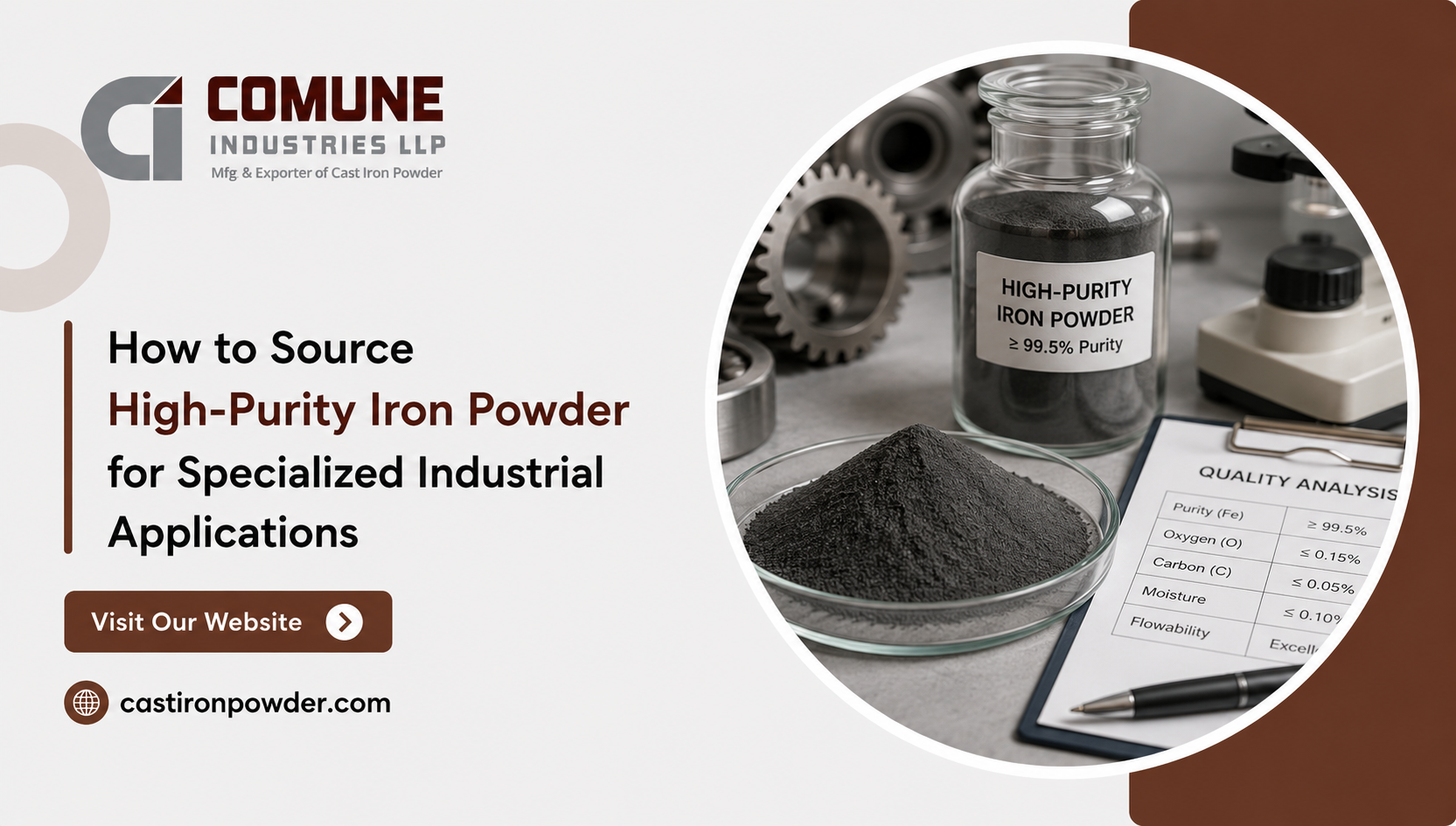
The "high-purity" designation typically means iron content upwards of 98–99%, with tightly controlled levels of residual elements. This distinguishes it from standard-grade or cast iron powder, which has a higher carbon content and is better suited to applications such as friction materials rather than precision metallurgy or electronics.
Buyers searching for specialized iron powder supplier relationships are usually doing so because their end product has a low tolerance for variability — a sintered gear, a welding consumable, or a component that needs predictable magnetic or electrical properties.
Industries That Require High-Purity Iron Powder
Powder Metallurgy
Powder metallurgy (PM) is one of the largest consumers of high-purity iron powder. Manufacturers press and sinter iron powder into near-net-shape components — gears, bearings, structural parts — where consistent particle size and low impurity levels directly affect part density, strength, and dimensional accuracy.
Welding
Iron powder is used as a filler and flux additive in welding electrodes and submerged-arc welding processes. Purity affects weld quality, arc stability, and the mechanical properties of the finished weld, making impurity control a non-negotiable spec for welding consumable manufacturers.
Automotive
Beyond powder metallurgy parts, the automotive sector uses iron powder in friction materials, magnetic components, and increasingly in lightweight structural applications where iron powder for industrial applications needs to meet strict OEM specifications.
Chemical
In the chemical industry, iron powder serves as a reducing agent and catalyst in processes such as nitrobenzene reduction. Here, surface area, reactivity, and purity determine process efficiency and product yield.
Electronics
Electronics manufacturers use fine, high-purity iron powders in soft magnetic composites, inductor cores, and shielding materials, where electrical and magnetic consistency is critical to component performance.
Critical Quality Parameters
When evaluating any batch of iron powder, buyers should scrutinize five core parameters:
- Purity: The percentage of elemental iron, along with the controlled presence (or absence) of sulfur, phosphorus, manganese, and silica. Even small deviations can affect mechanical and chemical performance downstream.
- Carbon Content: Carbon levels influence hardness, ductility, and how the powder responds to sintering or reduction processes. Applications like electronics and chemical processing typically require very low carbon content compared to structural or friction applications.
- Particle Size: Particle size distribution affects packing density, flowability, and how uniformly the powder sinters or reacts. Suppliers should provide sieve analysis data (mesh size distribution) for every batch.
- Flowability: Measured via standardized flow rate tests (e.g., Hall flowmeter), flowability determines how well the powder fills a die or mold — a critical factor in automated powder metallurgy production.
- Density: Both apparent density and tap density affect how much powder is needed per part and how consistent the final compacted or sintered product will be.
Buyers should always request a certificate of analysis (CoA) for each of these parameters — not a generic spec sheet, but batch-specific test data.
How to Evaluate an Iron Powder Supplier
Choosing a supplier goes beyond comparing price quotes. A thorough evaluation should include:
- In-house testing capability — Does the supplier operate its own lab and equipment (such as a spectrometer) to verify chemical composition on every batch, or do they rely on third-party or infrequent testing?
- Production capacity and consistency — Can they support your volume requirements without variability between batches or production runs?
- Certifications — Look for ISO 9001 (quality management), ISO 14001 (environmental management), and GMP compliance where relevant to your industry.
- Track record and export experience — Suppliers with established domestic and international distribution are more likely to have refined their quality control to meet varied regulatory and industry standards.
- Responsiveness and technical support — A supplier willing to discuss your specific application, rather than just selling off a catalog, is more likely to help you avoid costly mismatches between powder grade and end use.
Quality Standards Every Buyer Should Verify
Before finalizing a purchase, confirm the supplier can provide documentation and compliance around:
- ISO 9001:2015 certification for quality management systems
- ISO 14001:2015 certification for environmental management
- GMP compliance, particularly relevant for powders used in sensitive or regulated applications
- Batch-specific certificates of analysis, covering chemical composition, particle size distribution, and physical properties
- D&B D-U-N-S registration or equivalent business verification, which adds a layer of credibility for international buyers
These iron powder quality standards aren't just paperwork — they're a practical signal that a supplier has processes in place to catch defects before they reach your production line.
Questions to Ask Before Purchasing
When speaking with a potential supplier, buyers should ask:
- Can you provide a certificate of analysis specific to this batch, not just a general product spec?
- What testing equipment do you use in-house, and how frequently is each batch tested?
- What is your production capacity, and can you maintain consistent supply for our order volume?
- Do you offer free samples for testing before a bulk order?
- What is your typical lead time, and how do you handle quality issues or disputes if a batch fails to meet spec?
- Can you customize particle size, density, or purity levels to match our specific application?
Suppliers who answer these questions clearly and back them up with documentation are far more likely to deliver consistent, dependable material.
Why Comune Industries is a Trusted High-Purity Iron Powder Supplier
Comune Industries has been manufacturing iron and cast iron powder since 1988, growing into one of the largest producers and exporters in India with a production capacity of 1,500 tons per month. A few factors set the company apart for buyers evaluating specialized iron powder suppliers:
- In-house testing infrastructure, including an in-house spectrometer and laboratory for verifying both chemical and physical properties of every batch
- Certifications including ISO 9001:2015, ISO 14001:2015, and GMP compliance, along with D&B D-U-N-S registration
- Established export experience, supplying roughly 40% of production to overseas markets across Europe, North America, and Asia, alongside a strong domestic customer base
- Multiple production lines, supporting consistent supply and the flexibility to meet varied order volumes
- Government-approved Export House status, reflecting a track record of regulatory compliance and reliable international trade
For manufacturers looking for a high-purity iron powder supplier with the infrastructure and documentation to back up its claims, Comune Industries offers the kind of transparency and consistency that specialized applications demand.
Conclusion
Sourcing high-purity iron powder isn't just a procurement task — it's a decision that directly affects product quality, production efficiency, and long-term reliability. Buyers who take the time to evaluate purity levels, quality certifications, in-house testing capabilities, and a supplier's track record put themselves in a far stronger position than those who source on price alone.
Whether you're working in powder metallurgy, welding, automotive manufacturing, or chemical processing, partnering with an experienced, well-certified high purity iron powder manufacturer like Comune Industries can help ensure every batch meets the standards your application demands. If purity and consistency matter to your production line, it's worth reaching out for a sample and a batch-specific certificate of analysis before your next order.