Iron powder is an important raw material used across a wide range of industrial applications, including powder metallurgy, automotive components, welding products, magnetic materials, friction materials, and other engineered products. However, the quality and performance of iron powder depend significantly on how it is produced.
One of the established methods for producing high-quality iron powder is hydrogen reduction. This process uses hydrogen to remove oxygen from iron oxides, producing iron with controlled chemical and physical characteristics.
For manufacturers that require consistent raw materials, understanding the hydrogen reduced iron powder production process can help explain why reduction conditions, raw material selection, temperature, and process control are important.
At Comune Industries, careful attention to production parameters helps support the consistent quality required for industrial iron powder applications.
What Is Hydrogen Reduction of Iron Powder?
Hydrogen reduction is a process in which iron oxide is converted into metallic iron by reacting it with hydrogen at elevated temperatures.
The basic chemical reaction can be represented as:
Iron Oxide + Hydrogen → Iron + Water Vapour
During the process, hydrogen reacts with oxygen present in the iron oxide. The oxygen combines with hydrogen and forms water vapour, which is removed from the reaction environment. This gradually converts the iron oxide into metallic iron.
The resulting material can then be processed further to achieve the required particle size, morphology, density, and other characteristics.
This controlled conversion is one of the key reasons hydrogen reduction iron powder is used when manufacturers require iron powder with specific performance characteristics.
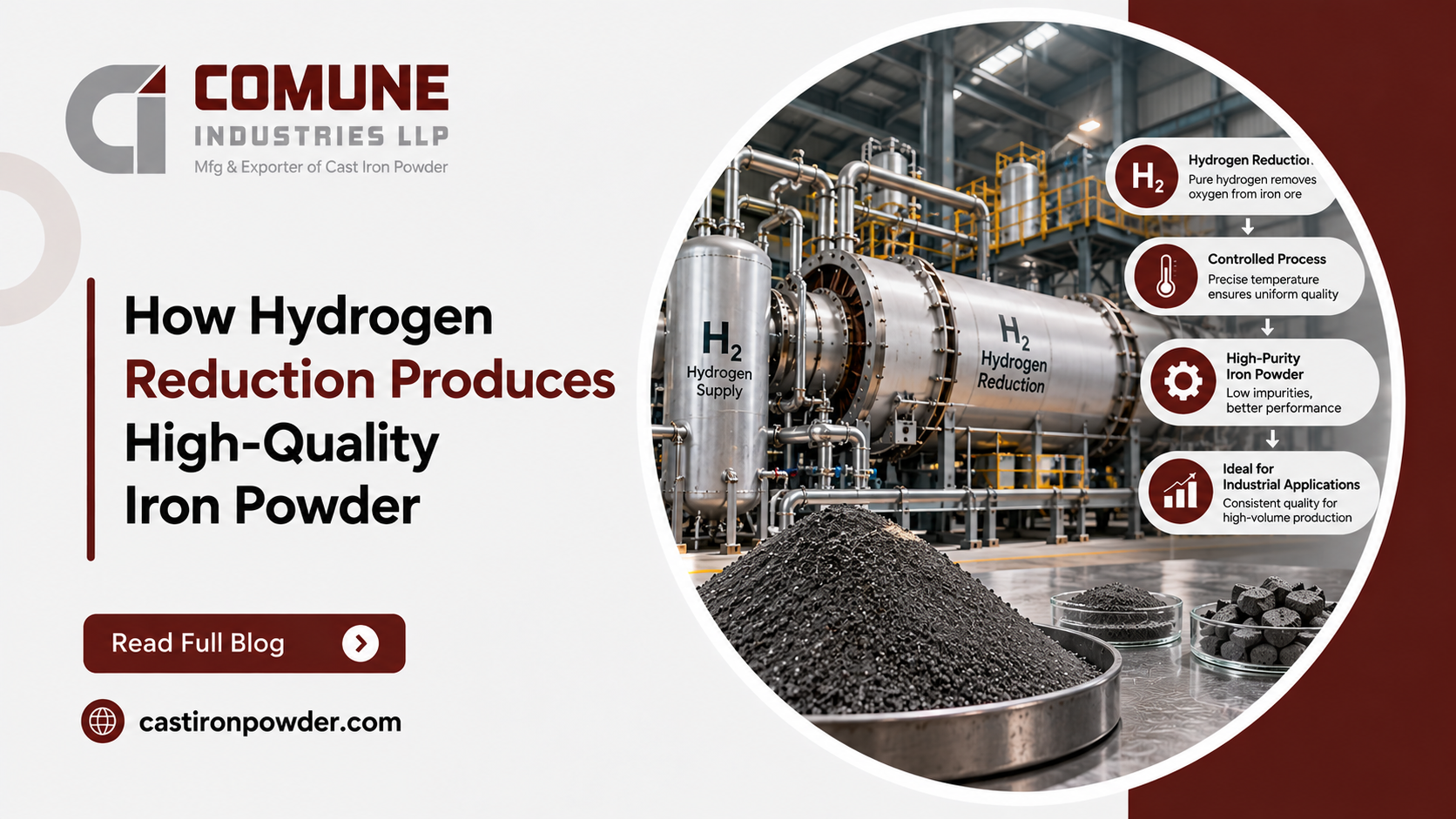
How Hydrogen Reduction Produces High-Quality Iron Powder
The quality of the final powder depends on several stages of the reduction process. Each stage needs appropriate control to achieve consistent results.
1. Selection of Suitable Iron Oxide Feedstock
The process begins with suitable iron oxide material. The chemical composition and physical characteristics of the feedstock can influence the quality of the final powder.
Impurities in the starting material may remain in the finished product or affect the reduction behaviour. Therefore, controlling the quality of the raw material is an important part of hydrogen reduced iron powder manufacturing.
Consistent feedstock helps manufacturers maintain more predictable chemical composition and production performance.
2. Controlled Heating
Hydrogen reduction generally takes place at elevated temperatures. The temperature must be carefully controlled because it affects the speed and effectiveness of the reduction reaction.
If the temperature is not appropriate, the reduction may be incomplete or the resulting iron structure may not meet the required specifications.
Controlled heating helps ensure that the iron oxide undergoes the intended transformation while maintaining the desired physical characteristics of the powder.
3. Hydrogen Removes Oxygen
The central stage of the process occurs when hydrogen comes into contact with the heated iron oxide.
Hydrogen reacts with oxygen in the oxide and produces water vapour. As oxygen is progressively removed, the oxide is transformed into metallic iron.
This oxygen-removal mechanism is the foundation of hydrogen reduction iron powder production.
The reduction atmosphere and gas flow must be managed carefully to maintain appropriate process conditions throughout the treatment.
4. Control of Reduction Conditions
Temperature alone does not determine the quality of the finished powder. Hydrogen flow, exposure time, atmosphere composition, and material loading can also influence the reduction process.
Consistent process conditions help reduce variations between production batches.
For industrial applications, this consistency is particularly important because manufacturers often need iron powder with predictable characteristics for downstream processing.
Important Characteristics of Hydrogen Reduced Iron Powder
The reduction process can influence several properties that are important for industrial applications.
Chemical Purity
Effective reduction removes oxygen from the iron oxide and produces metallic iron. Proper control of the process can help achieve the required chemical composition and minimize unwanted variations.
For applications where material purity is important, controlled hydrogen reduced iron powder manufacturing can provide a suitable production approach.
Particle Structure
The structure of iron particles can influence how the powder behaves during mixing, compaction, sintering, and other manufacturing operations.
The reduction conditions can affect the resulting particle morphology and porosity. These characteristics may influence powder flow, compressibility, and final component performance.
Consistency
Industrial users generally require raw materials that behave consistently from one batch to another.
Variations in particle size, chemical composition, moisture, or other properties can affect production processes. Controlled reduction and subsequent processing help manufacturers maintain more consistent powder characteristics.
Controlled Oxygen Content
One of the primary objectives of the reduction process is to remove oxygen from iron oxide.
Maintaining suitable reduction conditions helps achieve the required level of oxygen reduction and supports the production of high-quality reduction grade iron powder.
Why Hydrogen Is Used for Reduction
Hydrogen is particularly useful as a reducing agent because it reacts with oxygen and produces water vapour rather than introducing carbon into the reduction reaction.
This makes hydrogen reduction different from some carbon-based reduction methods.
The reaction can be summarized simply:
FeO + H₂ → Fe + H₂O
As the reaction proceeds, oxygen is removed from the iron oxide and water vapour is generated.
The ability to control the reduction atmosphere makes hydrogen useful for producing iron powders where chemical and physical consistency are important.
Factors That Affect Hydrogen Reduced Iron Powder Quality
Several factors can influence the final properties of the powder.
Raw Material Quality
Consistent iron oxide feedstock provides a stable starting point for the production process. Differences in impurity levels or composition can affect the final powder.
Reduction Temperature
Temperature affects reaction kinetics and the transformation of iron oxide into metallic iron. Maintaining suitable temperature conditions is therefore essential.
Hydrogen Flow
The supply and movement of hydrogen through the material influence the reduction environment. Appropriate gas flow helps maintain effective contact between hydrogen and the oxide.
Reduction Time
The material needs sufficient exposure to the reducing atmosphere to achieve the desired level of conversion. Insufficient treatment may result in incomplete reduction.
Cooling Conditions
After reduction, controlled cooling can also be important. Exposure to uncontrolled atmospheric conditions at elevated temperatures may affect the freshly reduced material.
These parameters need to be considered together rather than individually when developing a consistent production process.
Applications of Reduction Grade Iron Powder
High-quality iron powder produced through controlled reduction can be used across several industrial sectors.
Common applications include:
- Powder metallurgy components
- Automotive parts
- Sintered components
- Welding and brazing materials
- Magnetic applications
- Friction materials
- Chemical and industrial processes
- Metal injection and related powder-based manufacturing processes
The appropriate powder specification depends on the application, manufacturing method, and performance requirements.
For this reason, industrial buyers should consider factors such as chemical composition, particle size distribution, apparent density, flow characteristics, and other relevant specifications when selecting iron powder.
Importance of Consistent Manufacturing
For large-scale industrial production, consistency is just as important as the basic reduction process.
A powder that meets specifications in one batch but varies significantly in another can create challenges for downstream manufacturers. Variations may affect compaction behaviour, sintering performance, dimensional control, or the quality of finished components.
This is why hydrogen reduced iron powder manufacturing requires systematic process control from raw material preparation through reduction, cooling, processing, testing, and packaging.
A controlled manufacturing approach allows manufacturers to monitor important parameters and maintain the desired characteristics across production batches.
Choosing a Reliable Iron Powder Manufacturer
When sourcing reduction-grade iron powder, buyers should evaluate more than the material name alone. Important considerations include manufacturing capabilities, quality-control procedures, available specifications, particle characteristics, chemical composition, and consistency between batches.
A manufacturer with controlled production processes can better support applications where predictable powder behaviour is required.
Comune Industries focuses on manufacturing iron powder for industrial requirements with attention to production consistency and material quality. Customers can discuss their application requirements and required powder specifications with the manufacturer before selecting the appropriate grade.
Conclusion
Hydrogen reduction is an important method for producing high-quality iron powder because it converts iron oxide into metallic iron through a controlled reducing atmosphere. The process involves several critical stages, including raw material selection, heating, hydrogen exposure, reduction control, cooling, and subsequent powder processing.
The quality of hydrogen reduced iron powder depends on how effectively these parameters are managed. Proper control can help achieve suitable chemical composition, particle characteristics, oxygen levels, and batch-to-batch consistency.
For manufacturers using iron powder in powder metallurgy, automotive components, welding materials, and other industrial applications, understanding the hydrogen reduction iron powder process can make it easier to evaluate material specifications and production requirements.
With appropriate process control and quality management, hydrogen reduced iron powder manufacturing can provide a reliable route for producing reduction grade iron powder suited to demanding industrial applications.