Brake pads play a vital role in vehicle safety.
Every time a driver presses the brake pedal, the brake pads create friction against the rotor. This friction slows the vehicle and helps it stop safely.
However, braking creates extreme heat and pressure. Over time, these forces can wear down brake components.
That is why manufacturers use advanced materials to improve brake performance and durability.
One of the most important materials used today is iron powder for brake pads.
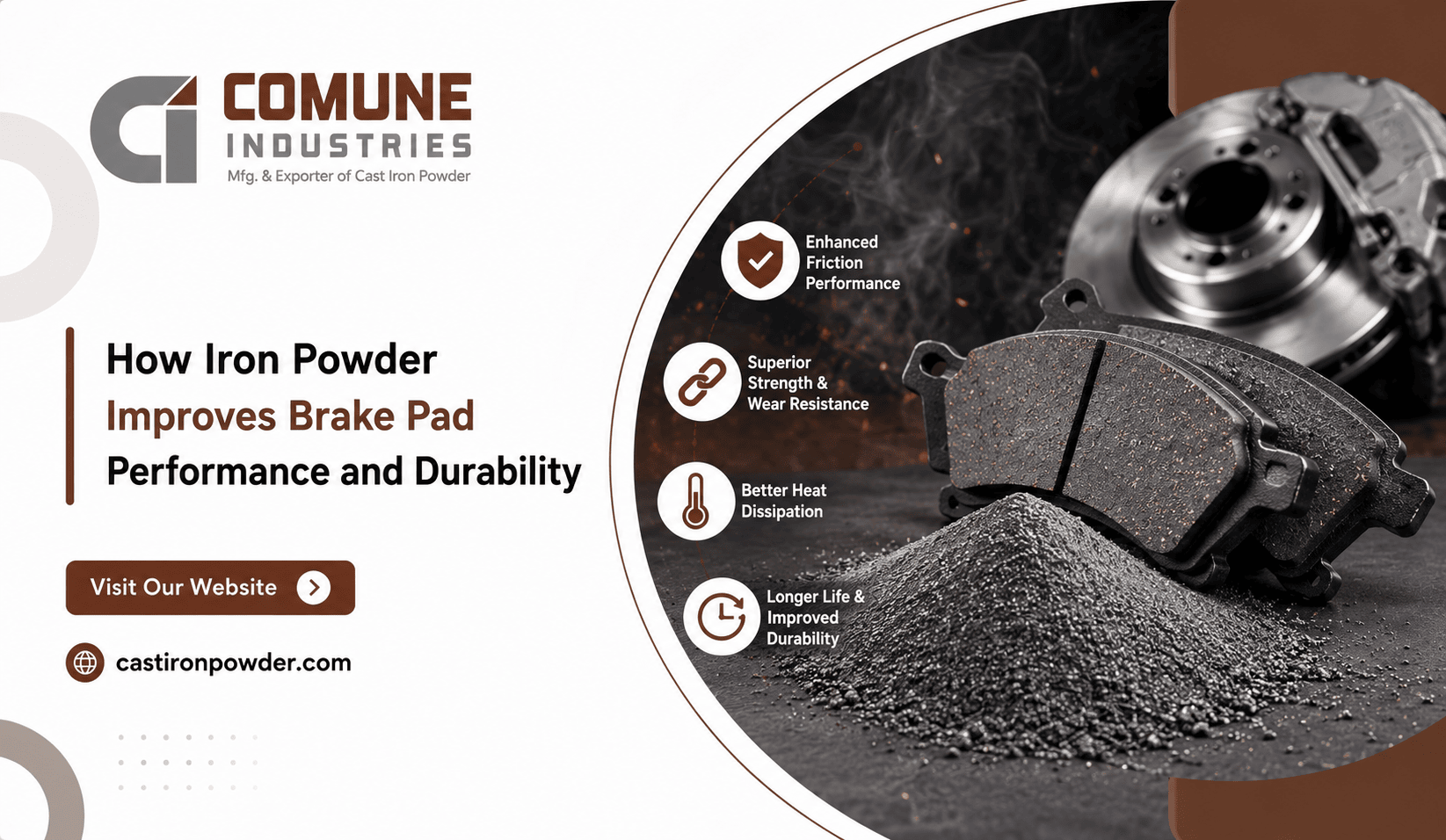
Iron powder helps increase friction, control heat, reduce noise, and extend the life of brake pads. It is widely used in modern brake friction materials for passenger vehicles, trucks, industrial equipment, and heavy machinery.
As demand for reliable braking systems grows, manufacturers continue to rely on high-quality cast iron powder supplied by trusted iron powder manufacturers in India.
In this guide, you will learn how iron powder works, why it is important, and how it improves brake pad performance.
What Is Iron Powder for Brake Pads?
Iron powder for brake pads is a specially processed metal powder used in semi-metallic and sintered brake pad formulations.
Manufacturers blend iron powder with other ingredients to create strong and durable brake friction materials.
Common materials used in brake pad formulations include:
- Phenolic resins
- Graphite
- Steel fibers
- Friction modifiers
- Lubricants
- Mineral fillers
These ingredients work together to provide stable braking performance under different operating conditions.
Iron powder plays a key role in this mixture. It improves friction, helps transfer heat, and strengthens the overall structure of the brake pad.
Because of these benefits, iron powder has become a standard material in many brake systems around the world.
Why Is Iron Powder Used in Brake Pads?
Brake pads must perform under challenging conditions.
During braking, temperatures can rise quickly. At the same time, the brake pad experiences constant pressure and friction.
Without the right materials, brake pads can wear out quickly or lose effectiveness.
Iron powder helps solve these problems.
It offers excellent thermal conductivity and wear resistance. It also supports stable friction performance.
These qualities make iron powder a valuable ingredient in modern brake friction materials.
Understanding Powder Metallurgy in Brake Pad Manufacturing
Powder metallurgy is a manufacturing process that uses metal powders to create solid components.
The process begins by mixing different powders.
Then we compress the material into shape and expose it to heat.
This creates a strong and uniform product.
Powder metallurgy offers several advantages for brake pad manufacturing.
Better Material Control
Manufacturers can control the exact composition of the brake pad.
This helps achieve the desired balance between friction, wear resistance, and durability.
Consistent Quality
The process produces uniform density throughout the brake pad.
This improves performance and reduces variation between batches.
Higher Strength
Powder metallurgy creates durable brake materials that can withstand demanding conditions.
Improved Wear Resistance
Brake pads produced through powder metallurgy generally last longer and perform more consistently.
Cost-Effective Production
The process reduces waste and improves manufacturing efficiency.
As a result, many brake manufacturers prefer powder metallurgy for high-performance applications.
How Iron Powder Improves Brake Pad Performance
Brake pads must create stable friction while controlling heat and wear.
Iron powder helps achieve all of these goals.
1. Better Friction and Stopping Power
The primary purpose of a brake pad is to generate friction.
Iron powder increases the friction level between the brake pad and rotor.
This improves:
- Braking response
- Vehicle control
- Stopping power
- Safety
Drivers benefit from quicker and more predictable braking performance.
This is especially important in heavy-duty vehicles and industrial equipment.
2. Improved Heat Dissipation
Heat is one of the biggest challenges in brake systems.
Each braking event creates thermal energy.
If too much heat builds up, braking performance can decline.
This condition is known as brake fade.
Iron powder helps transfer heat away from the friction surface.
As a result, brake temperatures remain lower.
Benefits include:
- Reduced brake fade
- Better thermal stability
- Longer component life
- More consistent performance
This makes iron powder ideal for vehicles that operate under heavy loads.
3. Increased Wear Resistance
Brake pads are exposed to constant friction.
Over time, this causes wear.
High-quality cast iron powder improves the strength of brake friction materials.
This leads to:
- Longer brake pad life
- Lower maintenance costs
- Better durability
- Reduced rotor wear
Manufacturers value iron powder because it helps create more reliable products.
4. Reduced Brake Noise
Brake noise can affect driving comfort and customer satisfaction.
Certain grades of sponge iron powder contain microscopic pores.
These pores help absorb vibration during braking.
As a result:
- Brake squeal decreases
- Vibration levels drop
- Comfort improves
This is one reason why iron powder is commonly used in modern semi-metallic brake pads.
5. Stronger Material Bonding
Brake pads contain multiple materials that must work together.
Iron powder helps create stronger bonds between:
- Resins
- Fillers
- Lubricants
- Reinforcement fibers
Strong bonding improves structural integrity.
It also helps prevent cracking and material separation.
The result is a brake pad that performs reliably for a longer period.
Key Benefits of Iron Powder for Brake Pads
Manufacturers choose iron powder because it offers several advantages.
Enhanced Durability
Iron powder improves wear resistance and extends service life.
Better Heat Control
Efficient heat transfer helps maintain braking performance.
Stable Friction
Iron powder supports consistent braking under different temperatures and conditions.
Lower Noise
Its porous structure helps reduce vibration and brake squeal.
Cost Savings
Longer-lasting brake pads help reduce replacement and maintenance costs.
Environmental Benefits
Iron powder supports low-copper brake formulations that meet modern environmental standards.
Conclusion
Iron powder is a key ingredient in modern brake friction materials. It improves braking performance, reduces heat build-up, and increases brake pad life. It also helps deliver safer and more consistent braking.
By sourcing quality cast iron powder from trusted iron powder suppliers in India like COMUNE INDUSTRIES, manufacturers can produce durable and reliable brake pads for a wide range of applications.