Buying iron powder without checking its product quality can lead to serious losses.
Many buyers focus only on price when purchasing metal powders. They place bulk orders, receive the material, and everything looks fine at first. But once production starts, problems begin. Parts fail. Performance drops. Rejection rates increase.
The biggest reason?
They never tested the powder samples before buying.
If you want consistent production and reliable output, checking iron powder quality is essential. It is not just about buying material—it is about maintaining strict quality control in your process.
In this guide, you will learn 7 practical tests to check iron powder quality before placing a bulk order.
Why Testing Iron Powder Quality Is Important
Iron powder is not a simple raw material. It is a critical component used in many industries like automotive, construction, and manufacturing.
Even small changes in metal powders can affect:
- Strength of components
- Wear resistance
- Production efficiency
Poor product quality can cause:
- Weak parts
- High rejection rates
- Increased production costs
- Machine inefficiencies
Testing powder samples before buying helps you:
- Compare suppliers accurately
- Avoid low-grade materials
- Ensure proper quality control
A professional supplier should test every batch. But as a buyer, you must verify it yourself.
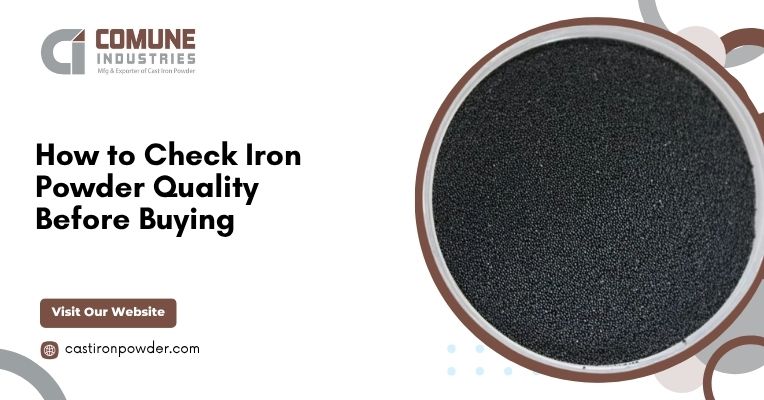
Test 1 — Visual Inspection (Quick and Effective)
Visual inspection is the simplest way to check product quality.
What to Check:
-
Colour
- Cast iron powder → Dark grey
- Pure iron powder → Light grey
- Uneven colour → Contamination
-
Texture
- Should feel smooth and consistent
- No lumps or sticky feel
-
Clumping
- Clumps indicate moisture
- Suggest poor storage
Foreign Particles
- Dust, stones, or debris indicate poor quality control
Why This Matters:
A quick visual check of powder samples can help you reject poor-quality metal powders instantly.
Test 2 — Moisture Content Check
Moisture is one of the biggest enemies of iron powder product quality.
- When moisture enters:
- Oxidation starts
- Powder degrades
- Performance drops
How to Test:
- Take a small powder sample
- Weigh it
- Heat at 105°C for 1 hour
- Weigh again
The difference = moisture content
What to Look For:
Low moisture → Good product quality
High moisture → Poor storage and weak quality control
Important Tip:
Always ask for moisture data in the Certificate of Analysis.
Test 3 — Particle Size (Mesh Size Verification)
Particle size plays a major role in how metal powders perform.
Why It Matters:
Too coarse → Poor compaction
Too fine → Flow issues
What to Ask:
Request the iron powder mesh size chart.
Common Applications:
- 10–30 mesh → Construction
- 30–60 mesh → Automotive
- 60–100 mesh → Friction materials
- 100–120 mesh → Precision parts
How to Test:
- Use standard sieves
- Pass powder samples through
- Measure distribution
What to Check:
Compare your test results with supplier data.
Mismatch means poor quality control.
Test 4 — Chemical Composition Testing
Chemical composition defines the real product quality of iron powder.
Key Elements:
- Carbon
- Sulphur
- Silicon
- Iron purity
Even small changes can affect performance.
How It Works:
A spectrometer analyzes the metal powders and gives exact results.
What to Ask:
Always request a spectrometer test report.
What to Check:
- Carbon content
- Sulphur levels
- Purity
Warning Sign:
If a supplier cannot provide this data, their quality control is questionable.
Test 5 — Flow Rate Test
Flow rate shows how smoothly metal powders move during production.
Why It Matters:
Poor flow causes:
- Uneven mould filling
- Weak components
- Production delays
How to Test:
- Use a Hall flowmeter
- Measure time for 50g powder sample
Result:
Seconds per 50 grams
What to Look For:
- Smooth flow → Good product quality
- Irregular flow → Poor performance
Flow rate testing is critical for maintaining production quality control.
Test 6 — Compressibility Test
Compressibility shows how well the powder compacts under pressure.
Why It Matters:
- High compressibility → Strong parts
- Low compressibility → Weak components
How to Test:
- Press the powder sample
- Measure density
Result:
Density (g/cm³)
What to Check:
- Higher density = better product quality
This test is essential for industries using metal powders in manufacturing.
Test 7 — Carbon Content Verification
Carbon content is a key factor in iron powder performance.
Why It Matters:
- Controls hardness
- Improves wear resistance
- Affects friction
Typical Range:
- Cast iron powder → 2% to 4%
How to Test:
- Combustion analysis
- Spectrometer testing
What to Check:
Carbon levels must match supplier specifications.
If not, the product quality is compromised.
How to Use These Tests When Choosing a Supplier
Here is a simple process to follow:
Step 1: Request Powder Samples
Never place bulk orders without testing powder samples.
Step 2: Perform Basic Checks
Start with:
- Visual inspection
- Moisture check
Step 3: Verify Documents
Ask for:
- Certificate of Analysis
- Chemical test reports
- Mesh size chart
Step 4: Conduct Key Tests
Check:
- Flow rate
- Compressibility
- Carbon content
Step 5: Compare Results
Match all values with your requirements.
Step 6: Place Trial Order
Test performance before scaling.
This process ensures strong quality control and reduces risk.
What a Reliable Supplier Should Offer
A professional supplier focuses on product quality, not just selling.
They Should Provide:
- Tested metal powders
- Verified powder samples
- Complete documentation
- Consistent batch quality
Essential Data:
- Chemical composition
- Mesh size distribution
- Flow rate
- Compressibility
- Moisture content
- Carbon levels
Strong quality control systems are a must.
Common Mistakes Buyers Should Avoid
Avoid these common mistakes:
1. Choosing Price Over Product Quality
Low price often means poor quality.
2. Not Testing Powder Samples
Skipping testing leads to risk.
3. Ignoring Quality Control Data
Always verify reports.
4. Not Matching Application Needs
Different uses require different metal powders.
Final Thoughts
Testing iron powder before buying gives you complete control over your production.
It helps you:
- Maintain high product quality
- Improve efficiency
- Reduce waste
- Strengthen quality control
Quick Summary of Tests:
- Visual inspection
- Moisture check
- Particle size
- Chemical testing
- Flow rate
- Compressibility
- Carbon content
These steps ensure you only work with high-quality metal powders.
Conclusion
If you want consistent results, never skip testing.
Always:
- Test powder samples
- Verify data
- Check supplier credibility
Strong quality control starts before you place the order.
Apply these 7 tests, and you will avoid costly mistakes while ensuring top-level product quality in your production process.