
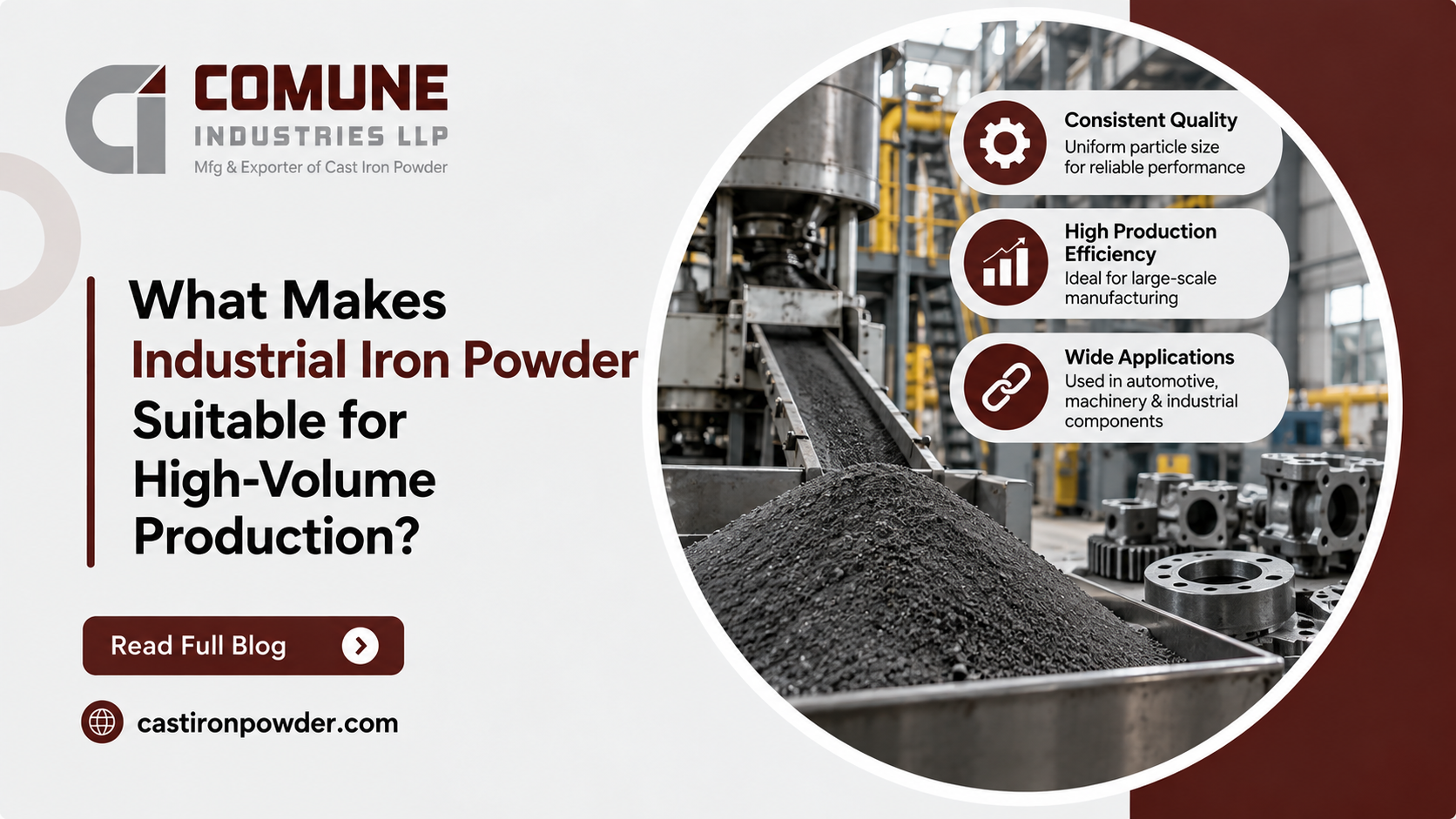
High-volume manufacturing requires raw materials that can deliver consistent quality, reliable performance, and predictable processing results across large production runs. In industries where powdered metals are used for forming, sintering, friction materials, welding, filtration, and other industrial applications, the quality of the powder can directly affect production efficiency and finished-product performance.
This is why industrial iron powder for high-volume production is widely used across different manufacturing processes. Iron powder offers a combination of controlled particle characteristics, chemical consistency, process compatibility, and material availability that makes it suitable for continuous and large-scale industrial operations.
For manufacturers, choosing the right iron powder is not simply about selecting a metal in powdered form. Factors such as particle size distribution, purity, flowability, bulk density, compressibility, and batch-to-batch consistency can influence how efficiently the material performs during production.
Comune Industries supplies industrial iron powder designed to meet the requirements of manufacturers looking for dependable material quality and consistent production performance.
Why Is Iron Powder Used in High-Volume Manufacturing?
Large-scale production environments require materials that behave predictably from one batch to another. Variations in raw materials can result in inconsistent processing, higher rejection rates, additional quality checks, and production delays.
Iron powder can be processed and engineered to provide specific physical and chemical characteristics required by different manufacturing applications.
Some important advantages include:
- Consistent particle characteristics
- Controlled chemical composition
- Good flowability
- Suitable compressibility
- Reliable sintering behaviour
- Compatibility with automated production processes
- Efficient material handling
- Availability for continuous industrial use
These characteristics make iron powder for mass production an important material for manufacturers that need repeatable results across thousands or millions of components.
Key Industrial Iron Powder Properties for Large-Scale Production
Not every iron powder performs in the same way. Manufacturers generally evaluate several material characteristics before selecting a suitable grade.
1. Particle Size Distribution
Particle size is one of the most important characteristics affecting powder behaviour.
A controlled particle size distribution can influence:
- Powder flow
- Packing behaviour
- Compaction
- Sintering
- Surface characteristics
- Final component density
For high-volume production, consistent particle size helps manufacturers maintain predictable processing conditions.
2. Chemical Purity and Composition
The chemical composition of iron powder can affect the performance of the final product and the stability of the manufacturing process.
Depending on the intended application, manufacturers may require controlled levels of iron content and specific limits for impurities.
Consistent chemical composition helps reduce unexpected variations between production batches.
3. Flowability
Powder flowability becomes particularly important when production involves automated feeding, filling, dosing, or moulding.
Powder that flows consistently through production equipment can help maintain accurate material delivery and reduce interruptions.
This makes flow behaviour an important consideration when selecting industrial iron powder for high-volume production.
4. Compressibility
For powder metallurgy applications, the ability of iron powder to compact effectively is essential.
Good compressibility can support the formation of components with the required dimensions and density before the sintering stage.
Consistent compressibility also helps manufacturers maintain similar processing conditions across repeated production cycles.
5. Bulk Density
Bulk density affects how much powder occupies a specific volume. It can therefore influence material handling, storage, die filling, and production calculations.
Maintaining consistent bulk density helps manufacturers establish repeatable processing parameters and improve production control.
6. Sintering Performance
Iron powder is commonly used in powder metallurgy, where compacted powder is heated under controlled conditions to develop the required mechanical and structural properties.
The powder's particle characteristics and composition can influence sintering behaviour.
For manufacturers producing large quantities of components, predictable sintering performance is important for maintaining consistent product quality.
Why Consistency Matters in Mass Production
One of the biggest requirements of large-scale manufacturing is repeatability.
A production line may process the same material continuously for hours, days, or weeks. If the characteristics of the raw material change significantly between batches, manufacturers may need to adjust machine settings or processing parameters.
This is why iron powder consistency is an important consideration for industrial buyers.
Consistent material characteristics can help manufacturers maintain:
- Stable production parameters
- Repeatable component dimensions
- Predictable material behaviour
- Consistent finished-product quality
- Efficient automated processing
- Reduced process variation
In other words, iron powder for mass production needs to perform consistently—not simply perform well in a single production batch.
Applications of Industrial Iron Powder
Industrial iron powder is used across a wide range of manufacturing applications. Its suitability depends on the specific grade, production method, and material characteristics required by the application.
Powder Metallurgy
Powder metallurgy is one of the major applications of iron powder. Manufacturers can compact and sinter metal powders to produce components with controlled shapes and properties.
This process is particularly useful for producing large quantities of components with repeatable geometries.
Friction Materials
Iron powder can be used as a metallic component in certain friction-material formulations.
Controlled powder characteristics can help manufacturers maintain consistency during mixing and processing.
Welding and Cutting Applications
Specific iron powder grades can be used in welding-related applications where powdered iron contributes to the required material composition or deposition process.
Chemical and Industrial Processes
Iron powder can also be used as an industrial raw material in selected chemical, metallurgical, and manufacturing processes.
The required specifications vary depending on the application, making grade selection important.
How Iron Powder Supports Automated Production
Automation is increasingly important in high-volume manufacturing. Automated systems require raw materials with predictable characteristics because material variation can affect feeding, dosing, compaction, and other production stages.
Consistent iron powder can support automated systems by providing predictable:
- Flow behaviour
- Feed rates
- Bulk density
- Particle distribution
- Compaction response
When material properties remain stable, manufacturers can establish production parameters more effectively and minimise unnecessary adjustments.
This is another reason industrial iron powder properties should be evaluated before selecting a material for a large-scale manufacturing process.
What Should Manufacturers Consider When Choosing Iron Powder?
Choosing the right powder requires more than looking at the product name. Manufacturers should consider the specific requirements of their application and production equipment.
Important factors include:
Application Requirements
First, determine how the powder will be used. Powder metallurgy, friction materials, chemical processing, and other applications can require different material characteristics.
Particle Characteristics
Particle size, morphology, and distribution can affect powder flow, packing, compaction, and processing behaviour.
Chemical Specifications
Check the required iron content and acceptable impurity levels according to the application.
Production Volume
For high-volume manufacturing, the supplier should be capable of maintaining reliable quality across repeated orders and production batches.
Quality Control
Consistent testing and quality-control procedures are important for maintaining iron powder consistency and identifying variations before the material enters production.
Packaging and Handling
Appropriate packaging helps protect the powder during transportation and storage while making it easier for manufacturers to handle the material efficiently.
Industrial Iron Powder vs. General-Purpose Iron Powder
The requirements for industrial production can be significantly different from those of small-scale or general-purpose applications.
Industrial buyers often need detailed specifications related to particle size, chemical composition, density, flowability, and other material properties.
For continuous production, these specifications are important because even relatively small variations can become significant when multiplied across a large number of components.
Therefore, manufacturers should select iron powder based on the technical requirements of their process rather than choosing a grade solely on price or availability.
Why Supplier Consistency Matters
The quality of the powder is only one part of the equation. Supplier reliability is equally important for manufacturers operating high-volume production lines.
A suitable supplier should be able to provide:
- Consistent product specifications
- Reliable batch quality
- Appropriate packaging
- Technical product information
- Quality-control support
- Reliable supply for repeat orders
At Comune Industries, consistency and application suitability are important considerations when supplying iron powder for industrial requirements. As an Iron Powder Manufacturer in India, the company focuses on providing consistent material specifications for manufacturers with different production requirements. Manufacturers can evaluate the appropriate powder specifications according to their production process, application, and required material characteristics.
Conclusion
High-volume manufacturing depends on consistency, repeatability, and reliable raw-material performance. Iron powder can meet these requirements when the material is produced with controlled particle characteristics, chemical composition, flowability, compressibility, and other relevant properties.
For manufacturers, the right industrial iron powder for high-volume production can contribute to stable processing and predictable results across repeated production cycles. However, the appropriate grade should always be selected according to the specific manufacturing process and technical requirements.
If you are evaluating iron powder for large-scale industrial applications, Comune Industries can help you identify suitable material specifications based on your production requirements and intended application.