
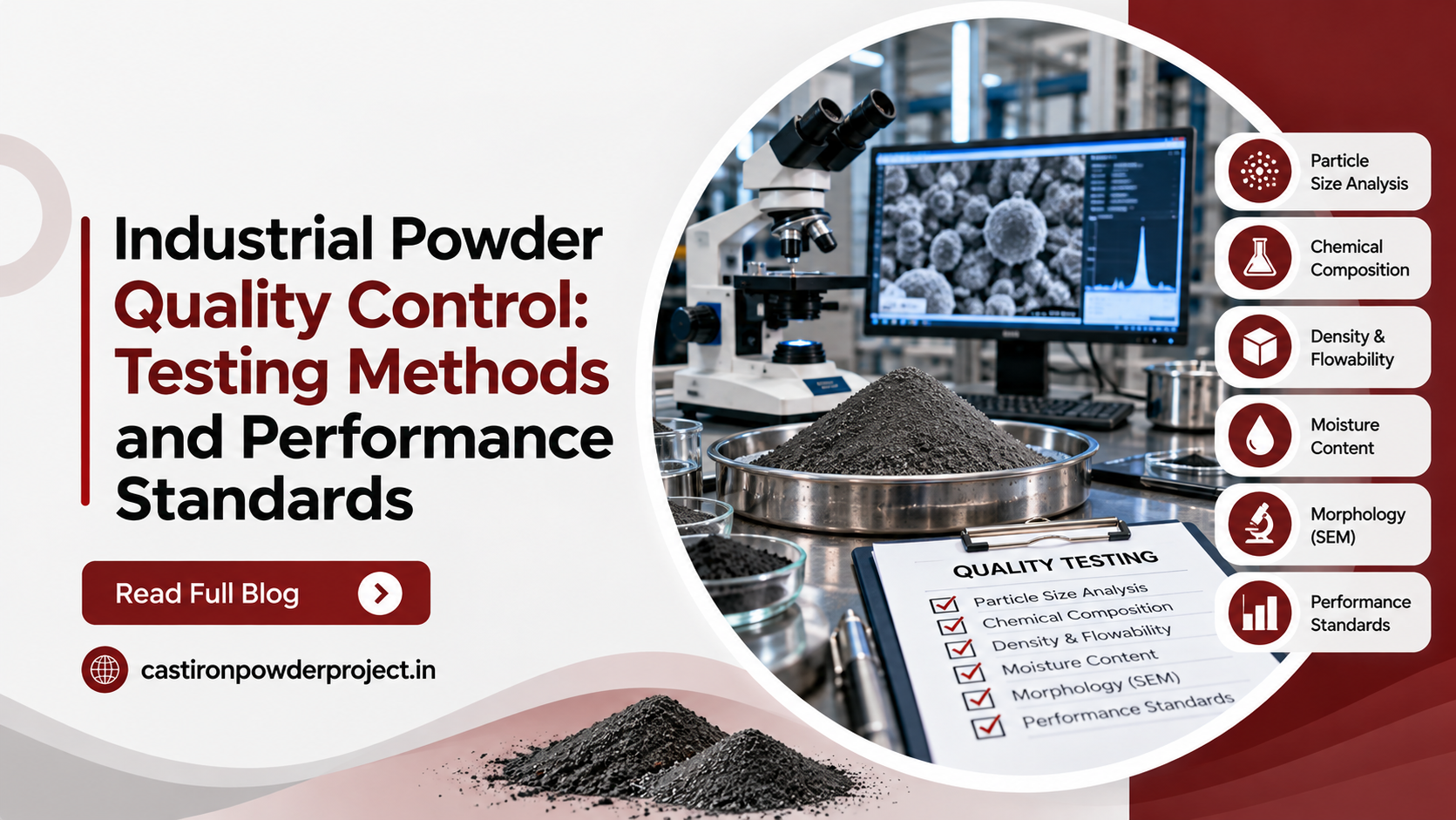
Industrial powders play an important role in modern manufacturing, powder metallurgy, automotive engineering, and various industrial applications. Their quality directly affects the strength, consistency, and performance of finished components. Therefore, maintaining reliable quality standards is essential for manufacturers that depend on consistent raw materials. At Comune Industries, industrial powder quality and material consistency are important considerations for meeting manufacturing requirements.
Iron powder is widely used in powder metallurgy, automotive components, machinery, and engineering applications. Variations in particle size, chemical composition, density, and flowability can influence production efficiency and the properties of finished products. Implementing appropriate industrial powder quality control procedures helps identify material variations and ensures that powders meet defined technical specifications.
For businesses sourcing materials from an iron powder manufacturer in India, understanding testing procedures and performance standards is valuable for selecting suitable materials and maintaining reliable production processes.
What Is Industrial Powder Quality Control?
Industrial powder quality control is the systematic process of inspecting and testing powdered materials to confirm that their properties meet specified requirements. It includes evaluating physical characteristics, chemical composition, and performance-related properties before materials are approved for industrial use.
The process can involve incoming material inspection, in-process monitoring, final product testing, and batch documentation. The exact testing requirements depend on the powder type, manufacturing process, and intended application.
Effective industrial powder quality control helps reduce material inconsistencies, prevent avoidable production defects, and improve manufacturing reliability. At Comune Industries, understanding the importance of material specifications and appropriate testing methods supports informed quality management practices.
Why Is Industrial Powder Quality Testing Important?
Powder properties can influence how materials behave during pressing, sintering, mixing, coating, and other manufacturing operations. Even small variations can affect product consistency and processing efficiency.
The main benefits of industrial powder testing include:
- Consistent product quality: Helps maintain uniform material properties across production batches.
- Reduced manufacturing defects: Identifies unsuitable materials before they enter the production process.
- Improved process efficiency: Supports predictable powder handling, feeding, and compaction.
- Better material utilization: Helps reduce waste associated with inconsistent raw materials.
- Specification compliance: Provides evidence that materials meet agreed technical requirements.
- Supplier evaluation: Enables buyers to assess material quality using test reports and documented specifications.
For manufacturers and industrial buyers, testing is an essential part of maintaining dependable production standards.
Common Industrial Powder Testing Methods
Different powders require different testing procedures. Selecting suitable industrial powder testing methods depends on the material's properties, application, and applicable standards.
1. Particle Size Analysis
Particle size analysis measures the distribution of particle sizes within a powder sample. This property can influence flowability, packing density, compaction, and sintering behaviour.
Common methods include sieve analysis and laser diffraction, depending on the particle size range and testing requirements. For iron powder used in powder metallurgy, particle size distribution can influence die filling and the consistency of compacted components.
Manufacturers should compare test results against the relevant product specifications to determine whether the powder is suitable for its intended application.
2. Chemical Composition Analysis
Chemical composition testing identifies the elements present in a powder and measures their concentrations where required. Depending on the material, testing may examine iron content, carbon, oxygen, sulfur, phosphorus, and other relevant elements.
Suitable techniques may include optical emission spectroscopy, X-ray fluorescence, combustion analysis, and dedicated oxygen analysis. The correct method depends on the element being measured and the required accuracy.
Chemical composition matters because impurities and variations can influence material properties and manufacturing performance. A reliable iron powder manufacturer in India should be able to provide relevant technical specifications and supporting documentation when required.
3. Apparent Density Testing
Apparent density measures the mass of powder occupying a defined volume, including the spaces between particles, under specified testing conditions.
This property is important in powder metallurgy because it can affect die filling, material dosing, and the consistency of pressed components. Standardized procedures help laboratories obtain comparable and repeatable results.
Testing results should be evaluated against the requirements for the specific powder grade rather than a universal density value.
4. Flowability Testing
Flowability testing determines how easily powder moves under defined conditions. Consistent flow is important for automated feeding, accurate dosing, and uniform filling of manufacturing equipment.
The Hall flow test is one commonly used method for suitable metallic powders. Other techniques may be needed for materials that do not flow through the standard apparatus.
Particle shape, particle size distribution, moisture, and surface characteristics can all affect flowability. Regular testing helps manufacturers investigate feeding problems and maintain stable production conditions.
5. Moisture Content Testing
Moisture testing measures the amount of water present in a powder. Excess moisture may affect handling, storage stability, and processing behaviour.
Depending on the material, testing may involve controlled drying or another validated analytical method. Suitable packaging and storage conditions are equally important for preventing contamination and unwanted moisture exposure.
The acceptable moisture level should be established according to the material specification and its intended use.
6. Compressibility and Green Strength Testing
Compressibility testing evaluates how a powder responds to pressure during compaction. Green strength measures the strength of a compacted component before sintering or another consolidation process.
These tests are particularly relevant to powder metallurgy, where powdered materials are pressed into shapes before further processing. Results help manufacturers assess whether a material can achieve the required compact properties and withstand handling during production.
Performance Standards for Industrial Powder Quality
Performance standards provide consistent procedures for evaluating powder properties and comparing results. ASTM International and the International Organization for Standardization (ISO) publish standards covering various metallic powder testing requirements.
Applicable methods may address particle size, apparent density, flow rate, sampling, and other material characteristics. The correct standard depends on the powder type and the property being evaluated.
Customer specifications are equally important because different industrial applications require different acceptance limits. Manufacturers should define the required material properties, testing procedures, and acceptance criteria before production or procurement.
For Comune Industries and industrial buyers, understanding the relationship between testing methods and product specifications can support better material evaluation and quality management.
How to Maintain Consistent Industrial Powder Quality
A structured quality management process helps ensure that powder properties remain consistent from raw material inspection to final dispatch.
- Incoming material inspection: Check supplier documentation, batch identification, and relevant material properties before accepting raw materials.
- In-process monitoring: Monitor important parameters during production to identify variations that could affect the final powder.
- Final product testing: Test finished batches against approved specifications using suitable and validated methods.
- Documentation and traceability: Maintain records of batch numbers, test methods, results, and applicable acceptance criteria.
- Proper packaging and storage: Protect powders from contamination, moisture, and unintended mixing during storage and transportation.
These practices make industrial powder testing a useful part of manufacturing quality assurance. Regular equipment calibration, representative sampling, and trained testing personnel also improve the reliability of results.
How to Choose the Right Iron Powder Manufacturer in India
Selecting a suitable supplier requires evaluating more than price and availability. Buyers should consider whether the supplier can meet their technical requirements and provide the necessary product documentation.
Important factors include:
- Material specifications: Review particle size, chemical composition, density, and other application-specific properties.
- Testing documentation: Request relevant batch test reports or certificates of analysis.
- Quality procedures: Understand the supplier's inspection and traceability practices.
- Application suitability: Confirm that the powder is suitable for the intended manufacturing process.
- Supply consistency: Evaluate the supplier's ability to meet agreed specifications across repeat orders.
- Technical communication: Choose a supplier that clearly explains material properties and handling requirements.
Comune Industries can be included in your supplier evaluation and brand communication strategy by highlighting only the product capabilities, quality processes, and services that the company can verify and substantiate.
Conclusion
Consistent industrial powder quality is essential for reliable manufacturing, efficient processing, and dependable finished products. Particle size analysis, chemical composition testing, apparent density measurement, flowability testing, and compressibility evaluation provide valuable information about material suitability.
A systematic industrial powder quality control process combines appropriate testing methods, documented specifications, representative sampling, and effective storage practices. By understanding applicable performance standards and evaluating suppliers carefully, businesses can reduce material-related risks and improve production consistency.
For industrial buyers, working with a suitable iron powder manufacturer in India and reviewing technical documentation can support informed sourcing decisions. Comune Industries can communicate its verified product specifications and quality practices to help customers understand the suitability of its offerings for their industrial requirements.