
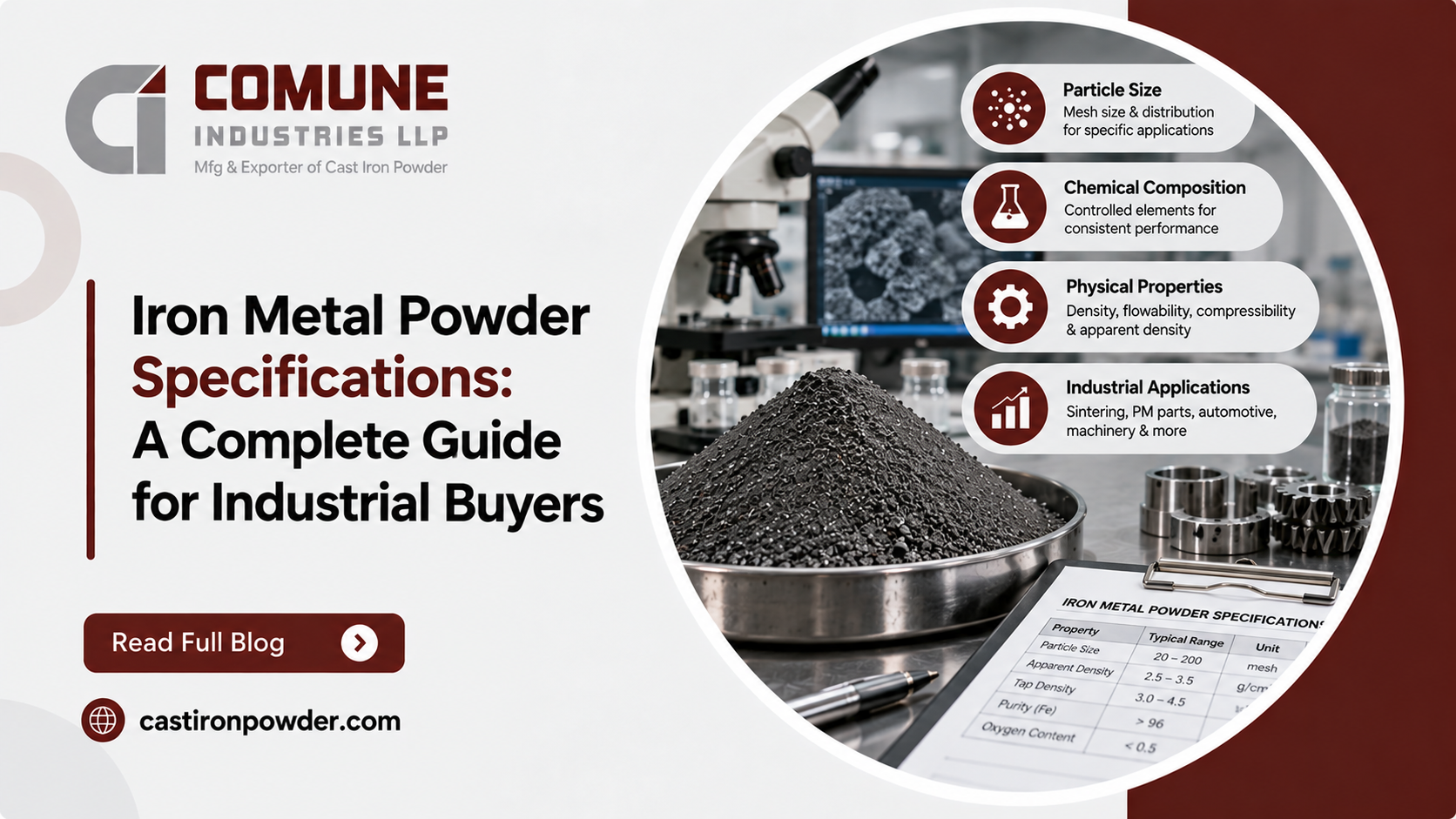
Choosing the right iron powder is important for manufacturers because powder characteristics directly affect production efficiency, component quality, dimensional consistency, and final product performance. Understanding iron metal powder specifications helps industrial buyers select a grade that matches their manufacturing process and application requirements.
Iron powder is used across several industries, including powder metallurgy, automotive components, welding, brazing, chemical processing, magnetic applications, friction materials, and industrial manufacturing. However, not all iron powders have the same characteristics. Particle size, chemical composition, purity, apparent density, flowability, and compressibility can vary significantly between grades.
This guide explains the key iron metal powder properties, common iron metal powder grades, and the importance of iron powder compressibility so industrial buyers can make informed purchasing decisions.
What Are Iron Metal Powder Specifications?
Iron metal powder specifications are the measurable physical and chemical characteristics used to define the quality and suitability of iron powder for a particular industrial application.
Important specifications can include:
- Chemical composition
- Iron content and purity
- Carbon and oxygen content
- Particle size distribution
- Particle morphology
- Apparent density
- Flow rate
- Compressibility
- Green strength
- Sintering behaviour
- Moisture content
- Magnetic properties
The required specification depends on how the powder will be processed. For example, powder metallurgy applications may place greater emphasis on compressibility, apparent density, particle size distribution, and sintering performance, while chemical applications may require specific purity and chemical composition.
For this reason, buyers should evaluate powder specifications based on the complete production process rather than selecting a grade only by its iron content.
Key Iron Metal Powder Properties Buyers Should Check
Understanding the major iron metal powder properties can help manufacturers compare different products and identify the appropriate material for their processes.
1. Chemical Composition
Chemical composition is one of the first specifications industrial buyers should review. Iron powder may contain controlled amounts of elements such as carbon, oxygen, manganese, silicon, sulfur, or other residual elements depending on the manufacturing method and grade.
Higher purity may be required for applications where chemical consistency and predictable processing are important.
Before purchasing, buyers should request a technical data sheet or certificate of analysis showing the relevant chemical composition.
2. Particle Size Distribution
Particle size affects powder flow, packing behaviour, mixing, compaction, and sintering.
Fine iron powder can provide a large surface area and may be useful in applications requiring finer particles. Coarser particles may offer different flow and packing characteristics.
A consistent particle size distribution is particularly important in high-volume manufacturing because significant variation can influence compaction behaviour and finished component consistency.
3. Particle Shape and Morphology
Particle morphology describes the shape and surface characteristics of individual powder particles.
Depending on the production method, iron powder particles can have irregular, sponge-like, or more rounded shapes. Particle morphology affects:
- Powder flowability
- Packing density
- Friction during compaction
- Compressibility
- Green strength
- Sintering behaviour
Manufacturers should therefore consider particle morphology alongside particle size rather than evaluating particle size alone.
4. Apparent Density
Apparent density refers to the mass of powder occupying a specific volume under defined testing conditions.
It provides useful information about how powder particles pack together before compaction. Consistent apparent density can contribute to predictable die filling and improved production control.
For manufacturers using automated or high-speed compaction equipment, stable powder behaviour can be particularly important.
5. Flowability
Powder flowability determines how easily iron powder moves through equipment, fills dies, and transfers between processing stages.
Good and consistent flow characteristics can help improve:
- Die filling
- Production speed
- Powder feeding
- Weight consistency
- Automated processing
Flowability is influenced by particle size, particle shape, surface characteristics, apparent density, and the presence of additives.
Understanding Iron Powder Compressibility
Iron powder compressibility is one of the most important properties for powder metallurgy applications.
Compressibility describes the ability of iron powder to compact under applied pressure and achieve a desired density. During compaction, loose powder particles rearrange, deform, and pack together inside a die.
Good compressibility can help manufacturers produce green compacts with suitable density and strength before sintering.
Factors affecting iron powder compressibility include:
- Particle size distribution
- Particle morphology
- Apparent density
- Lubricants and additives
- Compaction pressure
- Powder composition
- Processing conditions
Higher compressibility can be useful when manufacturers need higher green density or specific dimensional and mechanical characteristics after sintering.
However, compressibility should not be considered independently. A powder that performs well in one compaction system may behave differently under another set of tooling, pressure, lubrication, and processing conditions.
Common Iron Metal Powder Grades
Different iron metal powder grades are developed to meet different processing and performance requirements. The appropriate grade depends on the intended application and manufacturing method.
Some commonly considered categories include:
Reduced Iron Powder
Reduced iron powder is produced through a reduction process that removes oxygen from iron oxide. It can have irregular and porous particles, depending on the production process.
Its characteristics can make it suitable for applications requiring specific surface area, reactivity, and powder metallurgy performance.
Atomized Iron Powder
Atomized iron powder is produced by breaking molten iron into fine droplets that solidify into powder particles.
Depending on the atomization process, the particles can have relatively controlled shapes and particle size distributions. These characteristics can be useful for applications requiring consistent powder feeding and processing.
Electrolytic Iron Powder
Electrolytic iron powder is produced through an electrochemical process. It can offer high purity and distinctive particle morphology.
This type of powder may be considered for applications where chemical purity and controlled material characteristics are important.
High-Purity Iron Powder
High-purity grades are selected when low levels of impurities are important to the application. Buyers should review the complete chemical analysis rather than relying only on a general description such as “high purity.”
Iron Powder Specifications for Powder Metallurgy
Powder metallurgy is one of the major applications where detailed iron metal powder specifications are important.
The manufacturing process generally involves powder blending, compaction, and sintering. During these stages, powder characteristics influence the behaviour of the material and the properties of the finished component.
Important specifications for powder metallurgy can include:
|
Specification |
Why It Matters |
|
Chemical composition |
Influences material behaviour and final properties |
|
Particle size |
Affects packing, flow and sintering |
|
Particle morphology |
Influences compaction and flow |
|
Apparent density |
Helps evaluate packing behaviour |
|
Compressibility |
Affects achievable compact density |
|
Flowability |
Supports consistent die filling |
|
Green strength |
Helps handling before sintering |
|
Sintering behaviour |
Influences final component performance |
For production environments, consistency from batch to batch is often as important as the nominal specification itself.
How to Select the Right Iron Powder Grade
Industrial buyers should start by identifying the manufacturing process and the required final product characteristics.
Consider the following questions before selecting an iron powder:
What is the application?
Identify whether the powder will be used for powder metallurgy, welding, chemical processing, friction materials, magnetic applications, or another industrial purpose.
What particle size is required?
Particle size affects flow, packing, compaction, and processing behaviour.
What purity level is needed?
Review the chemical composition and allowable impurity levels according to the application.
What compressibility is required?
For compacted components, compare compressibility and density characteristics under relevant test conditions.
How important is flowability?
Automated production systems may require predictable powder flow and die filling.
Is batch consistency critical?
For high-volume production, consistent chemical and physical specifications can help reduce process variation.
Why Consistent Specifications Matter for Industrial Buyers
Industrial buyers should evaluate more than the price per kilogram when sourcing iron powder. Variations in powder characteristics can affect production efficiency, tooling behaviour, scrap rates, and finished component consistency.
A reliable supplier should be able to provide relevant technical information, including:
- Product grade
- Chemical composition
- Particle size distribution
- Apparent density
- Flow characteristics
- Compressibility data where applicable
- Testing information
- Packaging and storage recommendations
Clear specifications make it easier for manufacturers to compare products and determine whether a particular grade is suitable for their production requirements.
Why Choose Comune Industries for Iron Metal Powder?
Comune Industries focuses on supplying iron metal powder for industrial applications where material consistency and clearly defined specifications are important.
When evaluating an iron powder supplier, manufacturers should look for transparent technical information, consistent product quality, suitable grades, and support in selecting material according to the intended application.
Comune Industries can help industrial buyers evaluate relevant powder characteristics and identify an iron powder specification aligned with their manufacturing requirements.
Conclusion
Understanding iron metal powder specifications is essential for industrial buyers who need reliable material performance and consistent manufacturing results. Chemical composition, particle size, morphology, apparent density, flowability, and iron powder compressibility all influence how the material behaves during processing.
Different iron metal powder grades are designed for different requirements, so selecting the right product should begin with the application and manufacturing process rather than price alone.
By reviewing technical specifications, testing requirements, and batch consistency, manufacturers can make a more informed decision when sourcing iron powder. Comune Industries provides iron metal powder solutions for industrial buyers looking for clearly defined material characteristics and application-focused supply.