
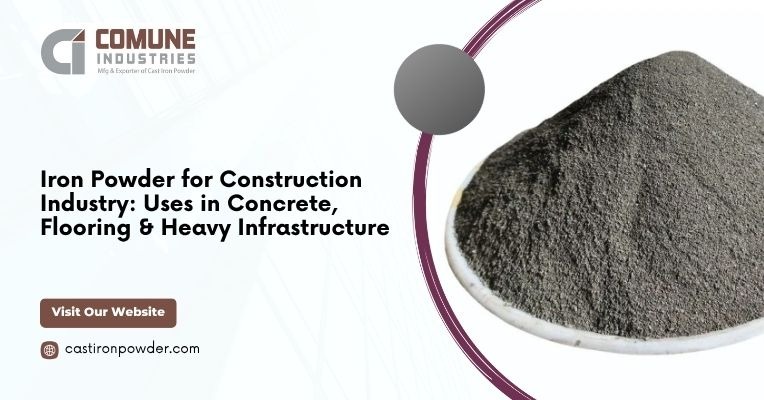
When most people think about construction materials, they think of cement, steel bars, or aggregates. But one material is quietly making its way into modern construction sites — and it is changing how engineers think about strength, durability, and surface performance.
That material is iron powder.
From reinforcing concrete mixes to improving iron flooring in heavy-duty industrial facilities, iron powder is finding new relevance across India's rapidly expanding construction and infrastructure sector. And manufacturers like Comune Industries are right at the centre of this growing demand.
In this guide, we break down everything you need to know — what iron powder actually is, the different types available, how it is used across construction applications, and how to choose the right grade for your specific project.
What Is Iron Powder and Why Does Construction Need It?
Iron powder is a finely processed metallic material made from cast iron or pure iron. Depending on the manufacturing method, it comes in different grades, particle sizes, and chemical compositions — each suited to specific industrial applications.
In the construction world, metal powder construction applications centre around using iron powder as a partial substitute for sand or cement in concrete mixes, as a dense aggregate in industrial flooring compounds, and as a filler or reinforcement material in heavy-load infrastructure projects.
What makes it valuable in construction is a combination of three core properties:
- High density: Significantly heavier than conventional sand, it increases the mass and load-bearing capacity of concrete.
- Wear resistance: Ideal for surfaces exposed to constant friction, heavy foot traffic, or machinery movement.
- Compressive strength: Research shows adding iron powder to concrete mixes can improve compressive strength by up to 17%.
What Are the Types of Iron Powder Used in Construction?
Not all iron powder is the same. Choosing the right type is critical to getting the results you need. Here is a breakdown of the main types and where each fits in construction:
1. Cast Iron Powder (Coarse Grade: 10–30 Mesh)
Cast iron powder in coarse grades is the most commonly used form in construction. Its large particle size makes it ideal for high-density concrete and structural fillers. Comune Industries manufactures this grade specifically with construction and heavy industrial applications in mind.
- Best for: Concrete mix reinforcement, structural fillers, heavy-duty flooring bases
- Key benefit: High bulk density and excellent load-bearing performance
2. Cast Iron Powder (Medium Grade: 30–60 Mesh)
Medium-grade cast iron powder offers a balance between particle size and surface area. It bonds well in concrete matrices and is often used in flooring compounds and precast elements.
- Best for: Industrial flooring compounds, precast concrete blocks, surface hardeners
- Key benefit: Uniform distribution for consistent mix performance
3. Black Iron Powder
Black iron powder, also produced by Comune Industries, is used in specialised construction coatings and pigment-based applications. It provides dark, uniform colouring and is used in decorative concrete, pigmented screeds, and surface protection coatings.
- Best for: Decorative concrete, pigmented flooring screeds, protective coatings
- Key benefit: Consistent colouring and surface density
4. Reduction Grade Iron Powder
This high-purity form is not typically used in bulk concrete but finds applications in specialised chemical and process-based construction activities — such as water treatment systems used in large infrastructure projects.
How Is Iron Powder Used in Concrete? A Step-by-Step Look
The use of iron powder in concrete is not complicated — but it does require understanding the right mix ratios and mesh grade. Here is how the process typically works:
Step 1 — Select the Right Mesh Grade
For concrete reinforcement, coarse cast iron powder (10–30 mesh) is recommended. For surface hardener applications or thin screeds, a finer 60–100 mesh grade works better. Comune Industries supplies multiple mesh grades specifically matched to construction requirements.
Step 2 — Determine the Replacement Ratio
Research recommends replacing 10–20% of fine aggregate (sand) with iron powder by weight. Going beyond 20% can affect workability, so staying within this range is important for most standard construction applications.
Step 3 — Mix and Test
The iron powder is added during the mixing stage — either into the dry mix before water is added, or as a partial substitute for fine aggregate. A trial batch should always be tested for compressive strength and workability before full-scale use.
Step 4 — Apply and Cure
Once mixed, the concrete containing iron powder is poured and cured normally. No special curing process is required — the material integrates seamlessly into standard construction workflows.
Pro Tip from Comune Industries:
For industrial flooring applications, using 30–60 mesh cast iron powder in the surface screed layer — rather than throughout the full slab — gives you the wear resistance benefit where it matters most, while keeping overall material costs lower.
Iron Powder Flooring Applications: Where Durability Meets Performance
Iron powder flooring applications are one of the fastest-growing uses of this material in India. Industrial and commercial spaces demand floors that can withstand constant use, heavy machinery, and harsh conditions — and iron flooring compounds deliver exactly that.
Industrial Factory Floors
Factories that operate heavy machinery, forklifts, or production lines need floors with exceptional hardness. Adding cast iron powder to the surface screed creates a high-density, abrasion-resistant finish that significantly outlasts standard concrete flooring. This is one of the primary industrial iron powder uses India is seeing growth in right now.
Warehouse and Logistics Floors
Large warehouses with constant vehicle movement and heavy racking systems benefit from iron powder enhanced flooring. The improved load distribution reduces cracking and surface degradation over time, lowering maintenance costs significantly.
Parking Decks and Ramps
Parking structures are exposed to repeated tyre wear, oil contamination, and weather. Iron powder flooring applications in these environments offer improved surface hardness and resistance to surface scaling — a major benefit for long-term durability.
Cold Storage and Processing Facilities
Temperature fluctuations cause standard concrete floors to crack over time. Dense, high-iron flooring compounds are more resistant to thermal expansion and contraction — making them well suited for cold chain and food processing environments.
Iron Powder in Heavy Infrastructure: Roads, Bridges & Beyond
Beyond buildings and floors, iron powder in heavy infrastructure is emerging as a material of interest across India's large-scale civil projects. With the government investing heavily in roads, bridges, ports, and urban transit systems, there is growing demand for construction materials that offer improved performance at a practical cost.
Road and Pavement Construction
High-traffic roads require surface layers with exceptional resistance to deformation and wear. Incorporating iron powder into pavement concrete or as part of a modified bituminous surface can improve load capacity and reduce long-term maintenance needs.
Bridge Decks and Structural Slabs
Bridge decks face a combination of dynamic loads, vibration, and weather exposure. Dense concrete incorporating cast iron powder construction grades has shown improved structural integrity and reduced permeability — both critical for long-life infrastructure.
Retaining Walls and Foundation Works
In heavy foundation work, dense aggregate mixes are often required to achieve specific gravity and load-bearing targets. Coarse-grade iron powder from Comune Industries can serve as a high-density aggregate additive in these applications.
Port and Industrial Zone Construction
Ports, container yards, and heavy industrial zones require flooring and structural elements that handle extraordinary loads. Iron powder for construction in these environments is valued for its contribution to density, abrasion resistance, and structural longevity.
Iron Powder vs Other Construction Aggregates: How to Choose
One of the most common questions engineers and procurement teams ask is: why use iron powder when traditional aggregates like sand, gravel, or fly ash are available? Here is a clear comparison to help you decide:
| Material | Iron Powder | River Sand | Fly Ash |
| Density | Very High | Medium | Low |
| Wear Resistance | Excellent | Moderate | Low |
| Compressive Strength Boost | Up to +17% | Baseline | Varies |
| Best Use | Heavy flooring, dense concrete | General construction | Lightweight fill |
| Cost Efficiency | High value for performance | Low cost | Very low cost |
The answer is not always one or the other. In many cases, iron powder is used to partially replace sand — giving engineers a targeted performance upgrade in high-stress zones without the cost of switching materials entirely.
How to Choose the Right Iron Powder Supplier for Construction Projects
Selecting the right metal powder construction supplier is as important as selecting the right material. Here is what construction professionals and procurement managers should look for:
1. Consistent Mesh Sizing
Particle size consistency directly affects concrete mix performance. A reliable supplier like Comune Industries maintains strict quality control across all mesh grades — from 10–30 coarse to 100–120 ultra-fine — so every batch performs as expected.
2. Verified Quality Certifications
Comune Industries holds ISO 9001:2015, ISO 14001:2015, and GMP certifications, along with in-house spectrometer testing. For construction projects — especially those with government or institutional oversight — certified suppliers are non-negotiable.
3. Bulk Supply Capability
Construction projects consume materials at scale. With a production capacity of 1,500 tonnes per month across four dedicated production lines, Comune Industries has the supply reliability to support large and long-duration projects without delays.
4. Technical Support and Sample Testing
Before committing to bulk orders, good suppliers offer free samples for laboratory testing. Comune Industries provides free samples specifically for this purpose — allowing engineers to verify performance against their project specifications before purchase.
5. Export and Logistics Experience
For infrastructure projects that span multiple states or involve international procurement, a supplier with government export house status and a strong logistics track record matters. Comune Industries exports to clients across Europe, Asia, and North America — confirming their delivery and documentation capabilities.
Industrial Iron Powder Uses in India: A Growing Market
India is currently experiencing one of the largest infrastructure build-outs in its history. The government's focus on highways, metro rail, industrial corridors, smart cities, and port development is driving unprecedented demand for high-performance construction materials.
Industrial iron powder uses India is directly benefiting from this trend. As engineers seek materials that go beyond baseline performance, iron powder for construction is being specified more frequently in:
- High-traffic industrial flooring in manufacturing parks and SEZs
- Dense concrete for road and pavement construction under PMGSY and NH programmes
- Structural fills and foundation works in port and coastal infrastructure
- Hardened flooring for cold chain and food processing zones
- Surface hardeners for warehouse and logistics park developments
Ahmedabad — where Comune Industries is based — is itself one of India's fastest-growing industrial and commercial hubs. The company's location gives it a strong supply chain advantage for construction projects across Gujarat, Maharashtra, Rajasthan, and beyond.
Cast Iron Powder Construction Uses: What the Numbers Say
The application of cast iron powder construction grades is backed by a growing body of research and field experience. Here are some of the key findings that support using iron powder in construction:
- Compressive strength: Up to 17% increase when 20% of sand is replaced with iron powder in standard concrete mixes.
- Flexural strength: Up to 28% improvement in flexural performance — critical for slabs and pavements under dynamic loads.
- Abrasion resistance: Complete sand replacement with iron powder shows a measurable decrease in surface abrasion — directly relevant to industrial flooring performance.
- Density: Iron powder increases concrete density significantly — beneficial for radiation shielding, counterweight structures, and high-load foundations.
These are research-backed figures from controlled mix design studies. For specific project applications, always commission a trial mix and independent lab testing — and request technical data sheets from your supplier.
Conclusion: Iron Powder Is Earning Its Place in Construction
Iron powder for construction is not a trend — it is a technically validated, practically proven material upgrade that is increasingly relevant to India's infrastructure ambitions.
Whether you are specifying iron powder flooring applications for a factory complex, evaluating iron powder in heavy infrastructure for a highway project, or simply looking for a durable sand alternative for your next concrete pour — understanding what iron powder can and cannot do puts you in a far better position as a decision-maker.
And when it comes to sourcing, Comune Industries brings decades of manufacturing experience, strict quality certifications, and the supply capacity to support projects of any scale. Based in Ahmedabad and exporting to markets across Asia, Europe, and North America, they are one of India's most established names in cast iron powder manufacturing.
Ready to explore iron powder for your next construction project? Visit castironpowder.com to request a free sample, access technical specifications, or speak directly with the Comune Industries team.