Introduction
Choosing the right iron powder mesh size is critical.
It affects your product quality, production consistency, and costs. Whether you make sintered components, friction materials, or specialty chemicals — particle size matters.
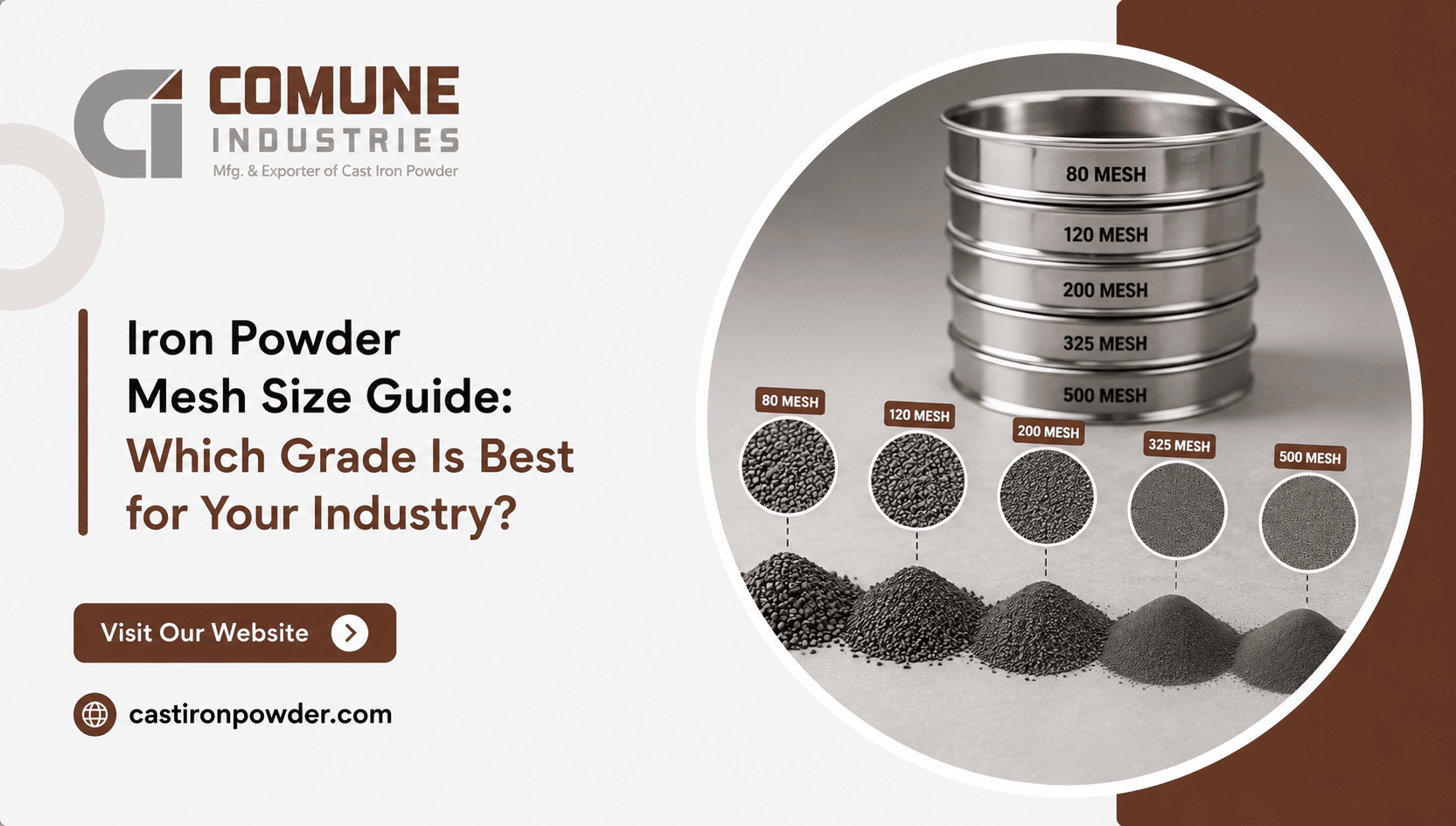
We measure iron powder particle size in mesh units. This is a standardized system. It tells you how many openings exist per inch in a sieve screen. The higher the mesh number, the finer the particle.
For example, 100-mesh iron powder passes through a sieve with 100 openings per inch. A 325-mesh grade is much finer, below 45 microns.
India's powder metallurgy sector is growing fast. Analysts expect the iron powder market to grow at over 5% CAGR through 2030. As demand rises, precision sourcing becomes more important.
Comune Industries has spent decades supplying cast iron powder and atomized iron powder to industries across India and globally. This guide covers everything you need to know.
What Is Iron Powder Mesh Size?
Mesh size classifies powder particles based on sieve openings.
The mesh number equals the number of openings per linear inch. A higher mesh number means smaller particles.
How it works:
- -100 mesh — all particles pass through a 100-mesh sieve
- -100/+200 mesh — particles are finer than 100 mesh but coarser than 200 mesh
In practice, iron powder particle size is measured in microns. Common industrial grades range from about 45 microns (-325 mesh) to over 500 microns (-35 mesh).
Always match mesh size to your process parameters and tooling tolerances.
Why Iron Powder Particle Size Matters
Particle size is not just a procurement detail. An engineering parameter. It directly affects your process and your final product.
1. Sintering Density and Mechanical Strength
Finer particles pack more densely under compaction pressure. This gives higher green density and better sintered strength.
Coarser particles reduce tooling wear. But they can hurt mechanical properties in tight-tolerance applications.
2. Flow Rate and Die Fill
Ultrafine powders (below 45 microns) tend to clump. They flow poorly. This causes inconsistent die fill in automated presses.
Medium grades — such as 100 to 200 mesh — usually offer the best balance. They provide good flowability and packing density for powder metallurgy applications.
3. Surface Area and Reactivity
Finer particles have a higher surface area. This makes them more chemically reactive.
In water treatment, chemical synthesis, and catalyst applications, very fine iron powder grades are often chosen for this reason.
4. Thermal and Electrical Conductivity
Particle size controls the contact area between grains during sintering. This directly affects thermal and electrical conductivity.
Industries making electromagnetic components must specify iron powder with tightly controlled particle distributions.
5. Surface Finish of Sintered Parts
Finer powders give smoother surfaces on sintered components. This reduces the need for secondary machining.
For precision bushings, filters, and bearings, this is a major advantage.
Iron Powder Grades: What You Need to Know
Iron powder grades depend on the manufacturing process, chemical purity, particle shape, and mesh size. Each grade has distinct properties suited to specific applications.
1. Atomized Iron Powder
Made by rapidly solidifying molten iron using high-pressure water or gas.
Key properties:
- Irregular or spherical particles
- Excellent compressibility
- Controlled apparent density
It is the most commonly used grade in powder metallurgy.
2. Reduced Iron Powder (Sponge Iron Powder)
Made by reducing iron oxide with hydrogen or carbon monoxide. The result is a porous, sponge-like particle.
Key properties:
- Very high purity
- Excellent compressibility
- Low residual carbon
Ideal for high-density structural PM parts, chemical processes, and food fortification.
3. Cast Iron Powder
Produced by grinding or atomizing cast iron alloys. It retains the carbon and silicon content of grey or white cast iron.
Key properties:
- Carbon content: 2 to 4%
- Silicon content: 1 to 3%
- Dense particle morphology
Widely used in friction materials, diamond tool bonding, and repair compounds. Cast iron powder suppliers in India stock this grade from -60 to -325 mesh.
4. Electrolytic Iron Powder
Made through electrodeposition. Achieves the highest purity — often above 99.5% Fe.
Key properties:
- Dendritic, sponge-like morphology
- Excellent green strength
- Very high purity
Used in high-performance PM parts, food fortification, and pharmaceuticals.
5. Carbonyl Iron Powder
Made through thermal decomposition of iron pentacarbonyl. Features near-perfect spherical particles at ultra-fine sizes.
Key properties:
- Sub-micron to -325 mesh particle sizes
- Very narrow particle size distribution
- High purity
Used in Metal Injection Moulding (MIM), microwave-absorbing materials, and medical devices.
How to Choose the Right Iron Powder Grade
Follow these steps to select the correct grade for your application.
Step 1 — Define your application requirements
Identify what your end product must achieve. A sintered bushing has very different requirements from a friction pad or a water treatment reagent.
Step 2 — Identify your process parameters
Document your:
- Compaction pressure range
- Sintering temperature and atmosphere
- Required green density and sintered density
- Dimensional tolerances and surface finish
- Chemical environment and reactivity needs
Step 3 — Select mesh size based on particle size distribution
Match your iron powder mesh size to your equipment constraints. Fine powders improve density but reduce flowability. Coarser powders flow better but may reduce sintered strength.
Step 4 — Evaluate grade purity and chemistry
For structural components, residual carbon and oxygen levels affect final mechanical properties.
For food or pharmaceutical use, only electrolytic iron powder with documented purity above 99.5% Fe is acceptable.
Step 5 — Consider cost versus performance
Carbonyl and electrolytic grades are premium-priced. For general-purpose PM applications, atomized or reduced iron powder offers the best value.
Ask your iron powder suppliers in India for current pricing and minimum order quantities.
Cast Iron Powder vs Other Iron Powder Grades
Cast iron powder is unique. Unlike pure iron grades, it keeps alloying elements from its parent material.
These are mainly carbon (2 to 4%) and silicon (1 to 3%).
This composition gives it properties that pure iron grades cannot match:
- Higher carbon content improves lubricity in friction applications
- Silicon content contributes to thermal stability in brake components
- Graphitic carbon acts as a solid lubricant in sintered friction materials
- Dense particle morphology supports high apparent density in die compaction
Industries that use cast iron powder:
- Automotive brake pad and clutch lining manufacturers
- Diamond segment and grinding wheel producers
- Cast iron repair putty and cold welding compound manufacturers
- Counterweight and ballast component producers
How to Select the Right Iron Powder Mesh Size
Follow this practical protocol when specifying mesh size for a new application.
- Run particle size analysis (PSA) to establish your baseline distribution
- Identify your critical cut-points: D10, D50, and D90 values
- Consult your compaction equipment supplier for recommended particle size ranges
- Request test samples in nearby mesh grades from iron powder makers in India.
- For example: -150, -200, and -325 mesh.
- Run comparative compaction trials
- Measure green density, ejection force, green strength, and sintered density for each trial
- Choose the mesh size that gives the best results at your target compaction pressure
- Lock in your specification with tight tolerances in your supplier quality agreement
Why Quality Matters When Choosing Iron Powder Suppliers
The quality of your iron powder determines the repeatability of your process. In automotive, aerospace, and food applications, poor-quality iron powder causes serious problems:
- Dimensional non-conformance in sintered parts
- Premature component failure and warranty claims
- Production stoppages due to poor flow or inconsistent compaction
- Regulatory non-compliance in food and pharmaceutical applications
- Customer rejections and loss of business
When evaluating iron powder suppliers in India, check these key quality indicators.
Certified Particle Size Distribution
Good iron powder manufacturers in India provide batch-level Certificates of Analysis (CoA) with D10, D50, and D90 values. This should be standard practice — not an optional extra.
Chemical Composition Traceability
Iron content, carbon, silicon, sulphur, phosphorus, and oxygen levels must be traceable to the raw material source. For cast iron powder, the carbon-to-silicon ratio is especially critical for friction performance.
Consistent Apparent Density and Flow Rate
Hall flowmeter flow rate and apparent density must be stable from batch to batch. Variations cause die fill inconsistencies in automated pressing operations.
ISO and Industry Certifications
Look for suppliers with ISO 9001:2015 certification as a minimum. Sector-specific certifications — such as IATF 16949 for automotive or FSSAI for food-grade — add further assurance.
Technical Application Support
The best iron powder suppliers in India provide application engineering support. They help troubleshoot process issues and optimise specifications for your specific conditions.
Why Industries Trust Comune Industries
Comune Industries is among India's leading iron powder manufacturers. We supply cast iron powder, atomized iron powder, and reduced iron powder to clients across automotive, industrial, chemical, and construction sectors.
Our facility produces iron powder from -35 mesh coarse grades to ultra-fine -325 mesh grades. This means we can serve diverse industry needs from a single, quality-assured source.
Why Choose Comune Industries?
- Batch-level CoA on every shipment
- Flexible order quantities — from sample lots to bulk tonnage
- Pan-India supply network with fast logistics
- Technical support for mesh size and grade selection
- Competitive pricing backed by stable raw material sourcing
- Trusted by automotive, construction, chemical, and food sector manufacturers
Conclusion
Choosing the correct iron powder mesh size is a precision engineering decision. It affects your product quality, process efficiency, and bottom line.
From -60 mesh coarse grades for welding electrodes to ultra-fine -325 mesh grades for MIM components. Every application needs a specific iron powder particle size profile.
As India's manufacturing sector grows, the need for precision-sourced iron powder will only increase. Partnering with experienced iron powder manufacturers in India gives your organisation a real competitive advantage.
Comune Industries can meet your needs for cast iron powder, atomized grades, and reduced iron powder. We also offer custom mesh blends. All products include verified Certificates of Verification and dedicated application support.