A single inconsistent batch of iron powder can ripple through an entire production line — throwing off sintering results, weakening a weld, or causing a part to fail dimensional tolerance. For manufacturers who depend on predictable metallurgical performance, quality consistency isn't a bonus feature; it's the baseline requirement. And the most reliable way a supplier can guarantee that consistency is through in-house laboratory testing for iron powder on every batch that leaves the facility.
Buyers increasingly ask suppliers not just what their product specifications are, but how those specifications get verified. This shift reflects a broader understanding: a spec sheet means little without the testing data to back it up. This article looks at why laboratory testing matters, what it typically covers, and what buyers should expect from a supplier serious about quality control.
Why Quality Consistency Matters
Iron powder is used in processes where small variations compound into significant downstream problems. In powder metallurgy, inconsistent particle size affects how a part packs and sinters, leading to variable density and strength. In welding applications, impurities can affect arc stability and weld integrity. In chemical processing, inconsistent reactivity changes yield and process timing.
Because these effects aren't always visible until a part is in production — or worse, in the field — consistency has to be verified before the material ships, not discovered after the fact. This is precisely why iron powder quality assurancedepends on rigorous, repeatable testing rather than periodic spot checks.
Common Iron Powder Quality Tests
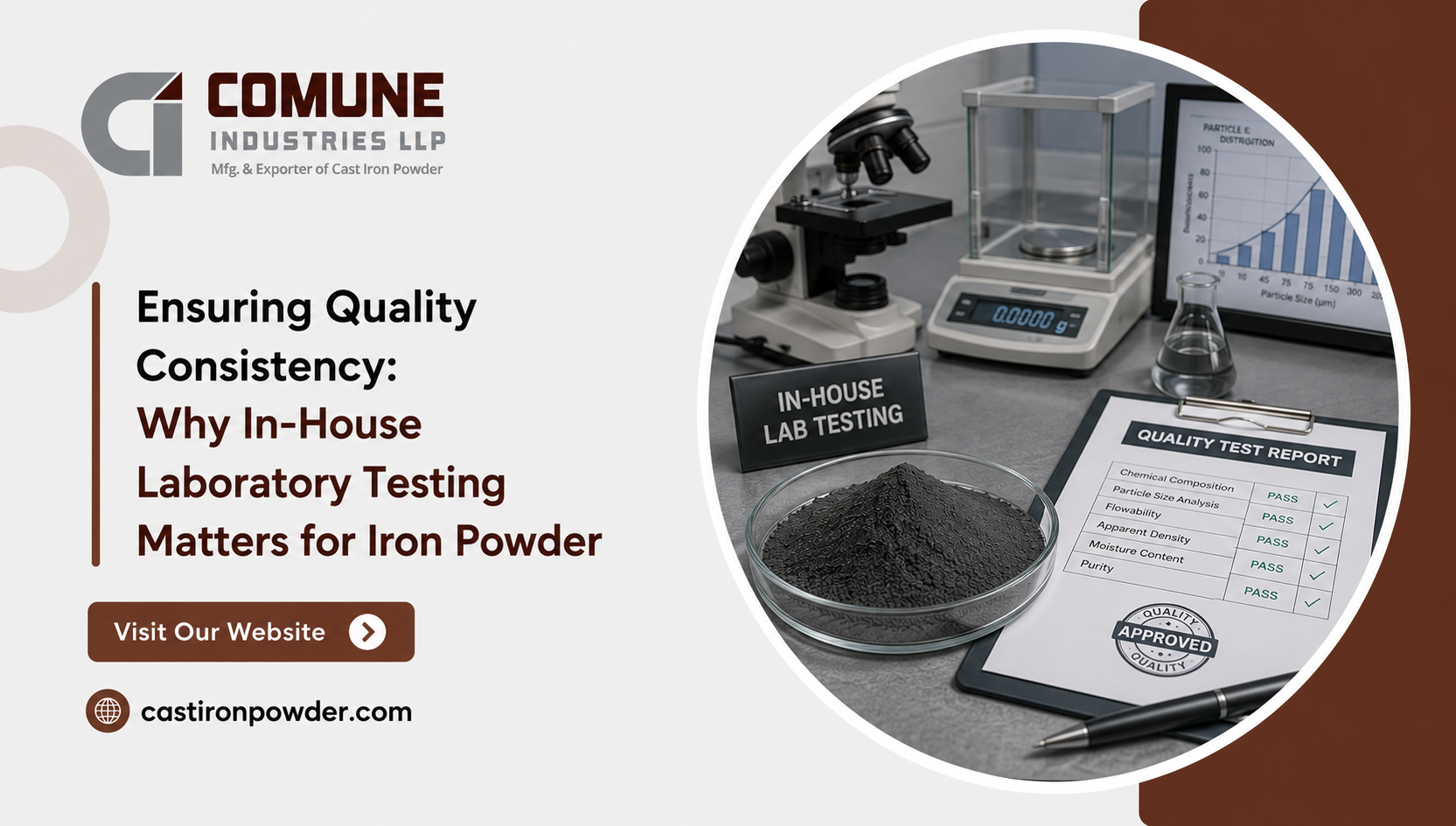
A thorough quality program typically covers five core tests for every batch:
Chemical Analysis
Using tools like optical emission spectrometers, manufacturers verify the precise percentage of iron along with trace levels of carbon, sulfur, phosphorus, manganese, and silica. This confirms the powder meets the purity grade promised to the buyer.
Particle Size
Sieve analysis determines the distribution of particle sizes within a batch, which directly affects flowability, packing density, and how the powder performs during compaction or sintering.
Moisture
Since iron powder is prone to oxidation and clumping when exposed to moisture, testing moisture content ensures the material will flow and process correctly and hasn't degraded during storage or transit.
Density
Both apparent density and tap density are measured to confirm how much powder is needed to fill a given volume — a critical factor for automated production processes where consistency between batches keeps output predictable.
Flow Rate
Using standardized methods such as a Hall flowmeter, manufacturers measure how quickly and evenly powder flows through a fixed orifice, which correlates directly to how well it will perform in automated die-filling or feeding systems.
Importance of In-House Laboratory Testing
Third-party testing has its place, but it introduces delays — samples need to be shipped, queued, and processed, often adding days or weeks to a supplier's ability to confirm quality. In-house testing changes that equation entirely. A manufacturer with its own laboratory and spectrometer equipment can:
- Test every batch before it ships, rather than relying on periodic or outsourced sampling
- Catch and correct quality deviations in near real time, before an issue reaches a customer
- Provide batch-specific certificates of analysis quickly, without waiting on external labs
- Maintain tighter process control by feeding testing data directly back into production adjustments
For manufacturers claiming to be an ISO certified iron powder manufacturer, in-house testing is often what makes that certification meaningful in practice — it's the operational backbone that keeps the documented quality system functioning day to day.
How Testing Improves Customer Confidence
When a supplier can hand over a certificate of analysis specific to the exact batch being shipped — not a generic spec sheet — it shifts the buyer relationship from one based on trust alone to one based on verifiable data. This matters most for buyers in regulated or high-precision industries, where a failed batch isn't just an inconvenience but a compliance or safety issue.
Consistent, transparent testing also reduces disputes. If a batch underperforms in a buyer's process, having detailed testing records from the manufacturer's side makes it far easier to isolate whether the issue originated with the material or elsewhere in the buyer's own process.
Industry Standards
Reliable iron powder quality testing typically aligns with recognized standards and certifications, including:
- ISO 9001:2015 for quality management systems, which requires documented process control and traceability
- ISO 14001:2015 for environmental management, relevant to how raw materials and by-products are handled during production
- GMP compliance, particularly important for powders destined for regulated or sensitive end uses
- Batch traceability documentation, allowing buyers to trace a specific shipment back to its production run and corresponding test data
Comune Industries Quality Process
Comune Industries has built its quality process around in-house verification rather than outsourced or infrequent testing. Key elements include:
- An in-house laboratory for testing both chemical and physical properties of every batch of iron and cast iron powder produced
- An in-house spectrometer, allowing rapid and precise chemical composition analysis without relying on external labs
- ISO 9001:2015 and ISO 14001:2015 certification, alongside GMP compliance, reflecting a documented and audited quality management system
- Four production lines supporting a capacity of 1,500 tons per month, with testing integrated at each stage of production
- A decade-plus track record of supplying both domestic and international customers, built on consistent, verifiable quality
For buyers evaluating suppliers on testing rigor rather than marketing claims alone, this kind of in-house infrastructure is a meaningful differentiator.
Conclusion
Quality consistency in iron powder isn't something buyers should have to take on faith. It's something a manufacturer should be able to prove, batch by batch, with real testing data. In-house laboratory testing gives suppliers the ability to catch problems early, respond quickly, and give buyers the documentation they need to trust every shipment.
For manufacturers like Comune Industries, that commitment to in-house verification — backed by ISO certification and years of production experience — is what turns a quality claim into a quality guarantee.