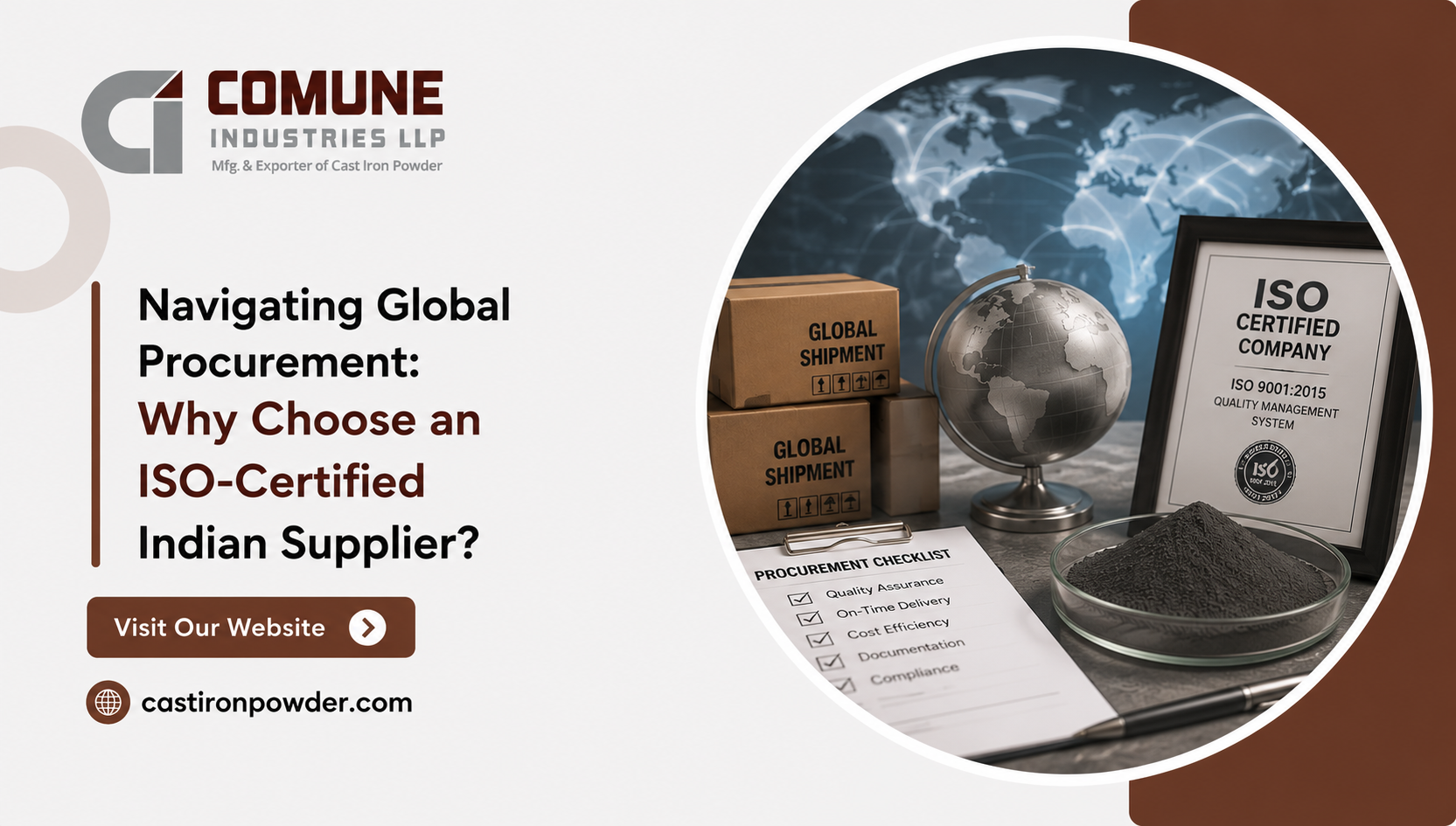
Global procurement teams face a common challenge: how do you trust the quality of a material you can't inspect in person before it ships across an ocean? For buyers sourcing iron powder, that trust usually comes down to one thing — certification. Working with an ISO certified Indian supplier gives international buyers a documented, auditable standard to rely on, rather than taking a manufacturer's word for it.
India has become a significant hub for iron powder production, combining competitive pricing with increasingly rigorous quality systems. But not every supplier in the market operates at the same level. For procurement managers evaluating overseas partners, understanding what ISO certification actually guarantees — and what else to look for — is essential to avoiding costly sourcing mistakes.
Why Global Buyers Prefer Indian Manufacturers
India's iron powder industry has grown around a combination of raw material access, established metallurgical expertise, and manufacturing capacity built up over decades. Many Indian producers operate multiple production lines, allowing them to serve both large-volume domestic demand and specialized export orders simultaneously.
For global buyers, this translates into practical advantages: competitive pricing relative to Western manufacturers, flexibility in order volumes, and a growing number of suppliers with export infrastructure already in place. A trusted iron powder exporter from India typically has years of experience navigating international shipping documentation, customs requirements, and buyer-specific packaging needs — reducing friction for companies procuring material for the first time.
Benefits of ISO Certification
ISO certification isn't just a badge on a website — it reflects a documented management system that a supplier is required to follow and that gets audited on a recurring basis. For buyers, this offers several concrete benefits:
- Standardized processes: ISO 9001 certification means a supplier has formal quality management procedures in place, from raw material intake to final batch testing.
- Environmental accountability: ISO 14001 certification indicates a structured approach to environmental management, which increasingly matters to buyers with their own sustainability commitments.
- Reduced variability: Certified suppliers are more likely to produce consistent batches over time, since their processes are documented and repeatable rather than dependent on informal practices.
- Easier audits: Certification simplifies the due diligence process for buyers, since much of the documentation a quality team would ask for already exists in a structured format.
What Makes an Iron Powder Supplier Export Ready?
Not every domestic manufacturer is equipped to serve international buyers. An export-ready ISO certified iron powder supplier in India typically demonstrates:
- Government export approval, such as recognized Export House status, confirming the company meets regulatory requirements for international trade
- Established shipping relationships and experience with export documentation, letters of credit, and international freight logistics
- Consistent production capacity, sufficient to fulfill large or recurring international orders without delays
- Multilingual or dedicated export support teams, capable of handling time-zone differences and international buyer communication
- A track record of overseas sales, ideally spanning multiple regions rather than a single market
Factors to Consider During Global Procurement
When evaluating a supplier for global procurement from India, buyers should weigh several factors beyond price:
- Certification and documentation — Does the supplier readily provide ISO certificates, batch test reports, and compliance documentation?
- Communication responsiveness — How quickly and clearly does the supplier respond to technical questions and quote requests?
- Sample availability — Will they provide a sample for independent testing before a bulk commitment?
- Production transparency — Can the supplier explain their manufacturing process and testing protocols in detail?
- Reputation and references — Are there verifiable existing customers, particularly in your region or industry?
Quality Assurance
Quality assurance in international procurement depends on more than a single inspection. Buyers should look for suppliers with in-house laboratory testing capabilities — including chemical composition analysis via spectrometer and physical property testing — applied consistently across every production batch, not just spot-checked occasionally. This ongoing testing discipline is what separates a supplier that merely claims high quality from one that can prove it with data on demand.
Packaging & Logistics
Iron powder is sensitive to moisture and contamination, so packaging matters as much as the material itself. Buyers should confirm that a supplier uses appropriate moisture-barrier packaging, proper container loading practices to prevent shifting during transit, and clear labeling that matches shipping documentation. Suppliers experienced in export logistics will also be able to advise on optimal container loads, appropriate Incoterms, and realistic lead times based on destination port and customs processing.
Why Comune Industries Meets International Buyer Expectations
Comune Industries has been manufacturing cast iron powder since 1988 and has built the kind of export infrastructure global buyers look for, including:
- ISO 9001:2015 and ISO 14001:2015 certification, alongside GMP compliance and D&B D-U-N-S registration
- Government-approved Export House status, reflecting an established track record in international trade
- Global distribution, with roughly 40% of production exported to buyers across Europe, North America, and Asia
- In-house laboratory and spectrometer testing, ensuring chemical and physical properties are verified before shipment
- Production capacity of 1,500 tons per month across four production lines, supporting both large-volume and specialized international orders
For procurement teams looking for an ISO certified Indian supplier with the documentation, capacity, and export experience to back up their claims, Comune Industries offers a level of transparency that reduces the guesswork in cross-border sourcing.
Conclusion
Global procurement always carries an element of risk when the buyer and manufacturer are separated by distance, time zones, and customs borders. Working with an ISO-certified Indian supplier helps close that gap, offering documented quality systems, established export experience, and a level of accountability that reduces uncertainty in the sourcing process.
For companies evaluating iron powder suppliers for international orders, prioritizing certification, transparent testing practices, and export readiness — as demonstrated by manufacturers like Comune Industries — is one of the most reliable ways to protect both product quality and supply chain continuity.