
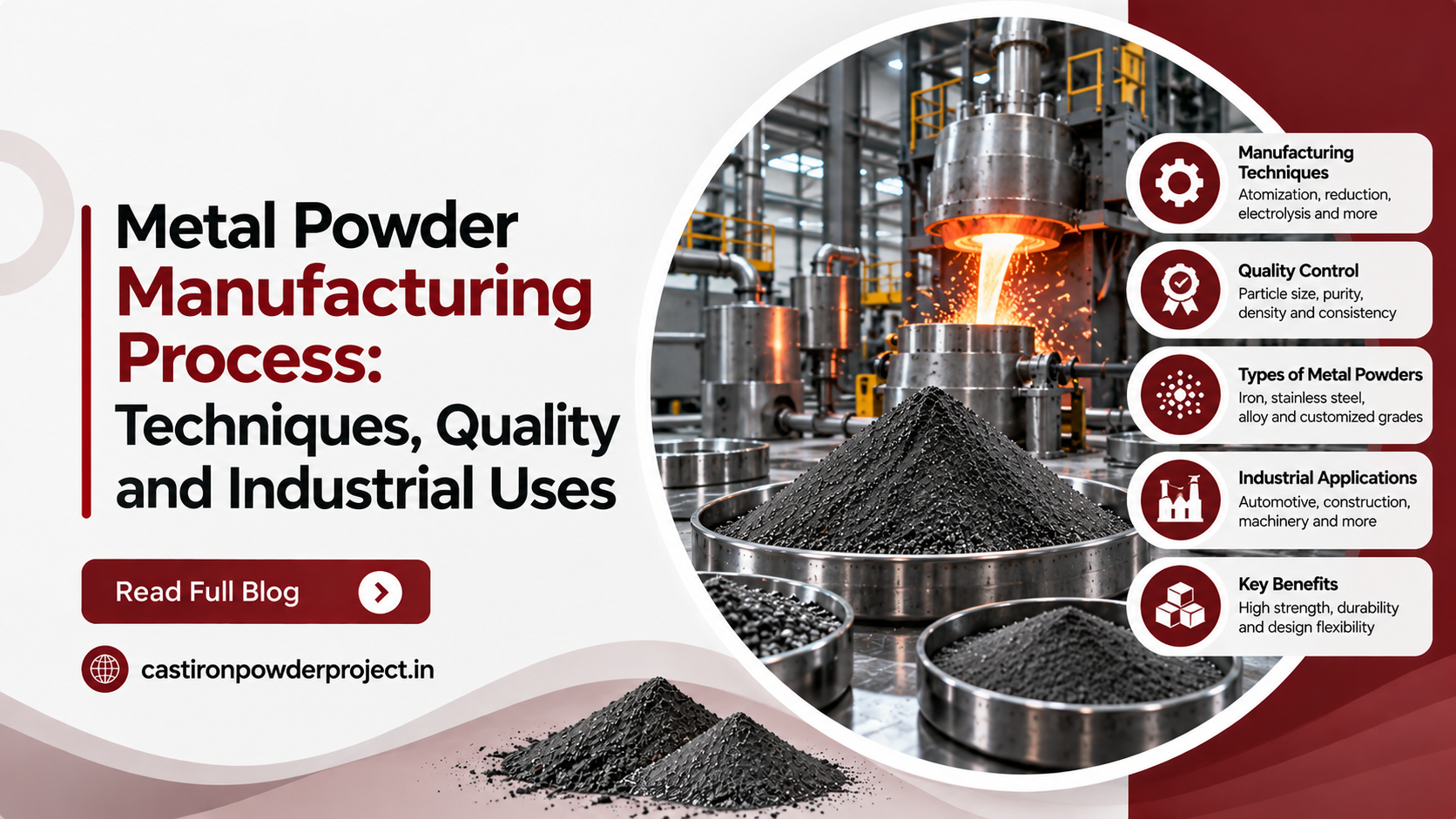
Introduction
Metal powders play an important role in modern manufacturing, supporting industries such as automotive, aerospace, construction, electronics, machinery, and metal fabrication. These finely divided metal particles are used to produce precision components, improve material performance, and support manufacturing processes that require consistent quality and efficient material utilization.
The metal powder manufacturing process involves converting solid metals into fine particles with specific sizes, shapes, compositions, and physical properties. The appropriate production method depends on the type of metal, its intended application, the required powder characteristics, and the quality standards of the final product.
Understanding different metal powder production methods helps manufacturers select suitable materials for their operations. From atomization and mechanical milling to chemical reduction and electrolytic processing, each technique offers different advantages and limitations.
At Comune Industries, understanding industrial material requirements is essential for helping buyers evaluate metal powders for their manufacturing needs. This guide explains the major production techniques, quality considerations, and industrial applications of metal powders.
What Is the Metal Powder Manufacturing Process?
The metal powder manufacturing process refers to the methods used to transform metals and metal-containing materials into small particles suitable for industrial applications. Depending on the technique, these particles may be spherical, irregular, flaky, or porous.
Manufacturers select a production method based on several factors, including:
- Metal composition: Different metals require different processing conditions.
- Particle size: Fine, medium, and coarse powders serve different purposes.
- Particle shape: Shape influences flowability, packing density, and compaction.
- Purity: Chemical impurities can affect the performance of the final component.
- Production volume: Large-scale applications may require continuous and cost-efficient processes.
- End-use requirements: Powder intended for additive manufacturing may require different characteristics from powder used in conventional powder metallurgy.
Once produced, metal powders may undergo screening, classification, blending, drying, or other treatments to meet the specifications required by customers.
Major Metal Powder Production Methods
Several manufacturing techniques are used to produce metal powders. Each method is suited to particular metals and applications, making it important to understand the differences before selecting a material.
1. Atomization
Atomization is a widely used method for producing metal powders from molten metal. The metal is first melted and then broken into small droplets using a high-pressure stream of gas or liquid. These droplets cool and solidify into individual particles.
The two common approaches are gas atomization and water atomization.
Gas atomization: In this process, a gas stream breaks molten metal into droplets. Gas-atomized powders are often relatively spherical and can offer good flow characteristics. These properties make them useful in additive manufacturing, metal injection molding, and other applications requiring controlled powder behavior.
Water atomization: Water jets break the molten metal into droplets that cool rapidly. The resulting particles are often more irregular than gas-atomized particles. This method is widely used for powders intended for compaction and conventional powder metallurgy.
Atomization can produce powders in a range of particle sizes. The final characteristics depend on the metal composition, atomizing medium, processing conditions, and subsequent classification.
2. Mechanical Milling
Mechanical milling reduces metal materials into smaller particles through repeated impact, compression, and friction. Equipment such as ball mills and specialized grinding systems may be used, depending on the material and desired powder characteristics.
This method is suitable for certain metals, alloys, and materials that require mechanical size reduction. It can also be used to blend different powder constituents or modify particle structures.
However, mechanical milling may introduce contamination from processing equipment, and excessive milling can alter particle shape or material properties. Manufacturers must therefore control processing time, equipment condition, and operating parameters.
Mechanical milling is particularly relevant when a specific particle size or powder structure is required rather than a spherical particle shape.
3. Chemical Reduction
Chemical reduction produces metal powders by converting metal oxides or other suitable compounds into metallic form through chemical reactions. A reducing agent removes oxygen from the metal oxide, leaving the metal in a powder form.
The resulting powder characteristics depend on the starting material, reduction temperature, atmosphere, reaction time, and post-processing steps.
Reduction is used in the production of certain iron powders and other metallic materials. Depending on the process, the resulting particles may have porous or irregular structures.
These characteristics can be useful in applications where compressibility, surface area, or other specific physical properties are important. Proper control of the process is necessary to achieve the required chemical composition and residual impurity levels.
4. Electrolytic Processing
Electrolytic processing uses an electrochemical reaction to deposit metal from an electrolyte. The deposited material can then be collected and processed into powder.
This method can produce metal powders with controlled chemical purity, depending on the metal, electrolyte composition, operating conditions, and refining procedures.
Electrolytic techniques are used for selected metals, including copper and iron. The powders may have dendritic or irregular particle structures, which can influence their packing and compaction behavior.
Although the method can offer advantages in purity and particle characteristics, production cost, energy requirements, and processing complexity must be considered when evaluating its suitability.
5. Other Specialized Production Techniques
Additional methods are used when conventional techniques cannot provide the required powder characteristics.
These include vapor-phase processes, specialized chemical synthesis, and certain solid-state production methods. Some techniques are designed for high-purity materials, while others support the production of fine powders or specific particle morphologies.
The best option depends on the metal being processed and the technical requirements of the intended application.
Factors That Influence Metal Powder Quality
Selecting an appropriate production method is only one part of manufacturing reliable metal powders. Quality control is equally important because variations in powder characteristics can affect downstream processing and final product performance.
Particle Size Distribution
Particle size influences how powder flows, packs, mixes, and compacts. A narrow particle size distribution may be necessary for certain precision applications, while a broader distribution can be suitable for other processes.
Manufacturers commonly use screening, sieving, or particle-size analysis to determine whether a powder meets the required specification.
Particle Shape and Morphology
Particle shape affects powder flowability, packing density, and the behavior of powder during processing. Spherical particles generally flow more readily, while irregular particles may provide mechanical interlocking or different compaction behavior.
The required shape depends on whether the powder will be used for additive manufacturing, pressing and sintering, coating, or another industrial process.
Chemical Composition and Purity
Chemical composition determines whether a powder meets the material requirements of its intended application. Elements such as carbon, oxygen, and other residual impurities may influence mechanical, thermal, magnetic, or chemical properties.
Suitable chemical analysis helps verify composition and identify unwanted contaminants. Buyers should review the material specification and certificate of analysis where applicable.
Flowability and Apparent Density
Flowability describes how readily a powder moves under specified conditions. Apparent density measures the mass of powder occupying a given bulk volume, including the spaces between particles.
Both properties matter when filling dies, feeding production equipment, or maintaining consistent manufacturing conditions. Test methods and acceptance limits should be selected according to the relevant application and industry standards.
Moisture and Storage Conditions
Moisture exposure and unsuitable storage conditions can cause oxidation, agglomeration, or changes in powder handling behavior, depending on the material.
Appropriate packaging, humidity control, and storage procedures help preserve powder quality during transportation and inventory management. Fine metal powders may also present combustible dust or other safety hazards, so handling procedures must reflect the specific material and its safety documentation.
Industrial Metal Powder Applications
The versatility of metal powders makes them useful across a wide range of industrial sectors. Their applications depend on chemical composition, particle characteristics, and the production technology used to transform the powder into a finished product.
Automotive Manufacturing
Automotive manufacturers use metal powders in powder metallurgy components, gears, bushings, structural parts, and selected wear-resistant components.
Powder metallurgy can support high-volume production with controlled dimensions and efficient material utilization. The selected powder must meet the mechanical and processing requirements of the component.
Aerospace and Advanced Engineering
Aerospace and advanced engineering applications may require metal powders with closely controlled compositions and particle characteristics. Certain alloys are processed into components using additive manufacturing or other specialized techniques.
Material traceability, powder consistency, and process qualification are particularly important when manufacturing parts subject to demanding performance requirements.
Construction and Infrastructure
Metal powders are used in selected construction-related materials, specialized repair products, coatings, and industrial formulations. Their suitability depends on the material chemistry and the performance requirements of the finished product.
For example, iron-based powders may be incorporated into particular engineered materials, but not every metal powder is appropriate for every construction application. Compatibility and relevant technical specifications must be evaluated before use.
Electronics and Electrical Components
Selected metal powders are used in conductive pastes, electrical contacts, electromagnetic components, and electronic manufacturing processes.
Applications may require specific conductivity, particle-size distribution, purity, or surface characteristics. Consistent material quality helps manufacturers maintain reliable production conditions.
Tooling, Coatings, and Surface Engineering
Metal powders can be used in thermal spraying, hardfacing, selected surface coatings, and specialized tooling applications. These processes can improve wear resistance, surface performance, or component service life when the powder composition and application method are properly matched.
The final results depend on factors such as coating thickness, substrate compatibility, processing parameters, and the properties of the selected powder.
How to Choose the Right Metal Powder Manufacturing Technique
Choosing between different metal powder manufacturing techniques requires a clear understanding of the final application and the manufacturing process in which the powder will be used.
Consider the following factors before making a selection:
- Define the application: Identify whether the powder is intended for pressing and sintering, additive manufacturing, coatings, or another process.
- Specify particle characteristics: Establish the required particle size, size distribution, shape, and flow properties.
- Confirm chemical requirements: Review composition, purity, and acceptable impurity levels.
- Evaluate production economics: Compare material costs, processing requirements, available quantities, and expected production volumes.
- Review testing and documentation: Request technical data sheets, applicable test results, and certificates of analysis where available.
- Assess supply consistency: Check whether the supplier can maintain the agreed specifications across repeat orders.
- Confirm handling requirements: Review packaging, transportation, storage, and material-specific safety information.
A technically suitable powder should meet both the material specification and the requirements of the downstream manufacturing process. Selecting on price alone can lead to inconsistent production, unnecessary waste, or additional quality-control costs.
Why Supplier Evaluation Matters
A reliable supply partner contributes to consistent material quality and predictable manufacturing operations. Buyers should evaluate more than the quoted price when comparing metal powder suppliers.
Important considerations include manufacturing or sourcing capabilities, quality-control procedures, product specifications, batch traceability, packaging standards, delivery commitments, and technical support.
For specialized applications, buyers should communicate their required grade, particle size, chemical composition, and testing criteria before placing a bulk order.
Businesses evaluating potential suppliers can also review the available product range and discuss application-specific requirements directly with the supplier. For procurement teams, clear technical communication helps reduce misunderstandings and supports a more consistent purchasing process.
Comune Industries recognizes the importance of evaluating material requirements carefully when sourcing industrial powders. Buyers should confirm the availability and specifications of the required material with the company before making technical or procurement decisions.
Choosing a Reliable Metal Powder Supplier
A dependable supplier contributes to consistent material quality and predictable manufacturing operations. Buyers should evaluate more than the quoted price when comparing suppliers.
Businesses looking for metal powder manufacturers in India should review product specifications, available grades, quality-control procedures, batch traceability, packaging standards, and delivery capabilities before placing bulk orders.
It is also important to communicate technical requirements clearly. Buyers should specify the required metal grade, particle size, chemical composition, quantity, and testing criteria before confirming a purchase.
For specialized applications, technical documentation can help determine whether a particular powder is suitable for the intended process. Buyers should confirm product availability, specifications, and quality documentation directly with the supplier.
Comune Industries understands the importance of evaluating material requirements carefully when sourcing industrial powders. Comparing technical specifications and supply capabilities helps procurement teams make informed decisions and maintain consistency in their manufacturing operations.
Conclusion
The metal powder manufacturing process combines several techniques, including atomization, mechanical milling, chemical reduction, and electrolytic processing. Each method produces powders with different characteristics, making the selection process dependent on the metal composition, particle properties, quality requirements, and intended application.
Understanding metal powder production methods helps industrial buyers assess the trade-offs between purity, particle shape, flowability, production cost, and performance. Equally important are quality testing, suitable storage, material documentation, and supplier consistency.
For manufacturers, choosing the right powder involves matching technical specifications with the demands of the production process. Comune Industries can be considered as part of the supplier evaluation process, with buyers encouraged to confirm product availability and technical specifications directly before purchasing.