Introduction
The powder metallurgy process is now one of the most important advanced manufacturing methods in modern industry. It helps manufacturers produce strong, precise, and cost-efficient metal parts with very little material waste.
As industries demand higher accuracy and faster production, powder-based metal processing is becoming the preferred choice in automotive, engineering, machinery, and aerospace sectors.
At the center of this powder metallurgy process, iron powder plays a key role. It is a key raw material used to make high-strength, near-net-shape components with excellent dimensional accuracy. From gears and bearings to structural automotive parts, iron-based powders are widely used in modern powder metallurgy manufacturing.
In addition, manufacturers also rely heavily on cast iron powder and industrial-grade ferrous powders. These materials help achieve consistent quality, better performance, and sustainable production. As a result, demand for iron powder manufacturers in India and global suppliers continues to grow. COMUNE INDUSTRIES is among the trusted manufacturers serving industries with high-quality iron powder and cast iron powder solutions.
In this guide, you will learn:
- What powder metallurgy is
- How iron powder is used
- Step-by-step powder metallurgy process
- Key applications and benefits
- How industries choose suppliers
What Is Powder Metallurgy?
What is powder metallurgy?
Powder metallurgy is a manufacturing process where fine metal powders are pressed into shape and then heated to form solid metal parts.
Definition
Powder metallurgy is a process in which metal parts are made by compacting and sintering metal powders instead of melting metal.
History and Evolution
Powder metallurgy is not new. It has been used in basic forms for centuries. However, modern industrial use began in the 20th century with advances in metal powder technology and precision engineering.
Today, it is widely used in advanced manufacturing technologies for mass production of complex metal parts.
Importance in Modern Manufacturing
Powder metallurgy is important because it allows:
- Near-net-shape manufacturing
- High material efficiency
- Less machining work
- Mass production with consistency
- Flexible product design
Why Industries Use It
Moreover, industries prefer powder metallurgy because it produces precision metal components with tight tolerances, less waste, and lower cost.
Understanding Iron Powder and Its Industrial Importance
What Is Iron Powder?
Iron powder is fine metallic iron made using industrial processes. It is widely used in powder metallurgy materials to produce strong and durable components.
How Iron Powder Is Produced
Iron powder is made using different methods:
- Water atomization
- Gas atomization
- Reduction of iron oxides
- Mechanical milling
Each method controls particle size, purity, and density. As a result, industrial requirements are met with precision.
Characteristics of Industrial Iron Powder
Industrial-grade iron powder offers:
- High compressibility
- Uniform particle size
- Good sintering behavior
- High purity
- Suitable density control
Benefits in Manufacturing
Iron powder is used to make:
- Sintered metal components
- Automotive parts
- Machinery parts
- Electrical components
In addition, it is widely used in ferrous powder metallurgy and industrial production.
What Is Cast Iron Powder?
Definition
Cast iron powder is a type of iron-based powder made from cast iron material. It is designed for high strength and wear resistance.
Composition
It generally contains:
- Iron (Fe)
- Carbon (C)
- Silicon (Si)
- Small alloying elements
Key Properties
Cast iron powder offers:
- High wear resistance
- Strong mechanical strength
- Good thermal stability
- Stable performance after sintering
- Good machinability
Advantages Over Traditional Materials
Compared to cast or machined metals, it provides:
- Less material waste
- Lower machining cost
- Flexible design options
- Consistent quality
Why Industries Use It
Industries choose cast iron powder because it supports:
- Mass production
- Complex part design
- Cost efficiency
- Reliable performance
COMUNE INDUSTRIES supports OEMs and industrial buyers with consistent material quality, reliable supply chains, and industry-focused metal powder solutions.
Step-by-Step Powder Metallurgy Process
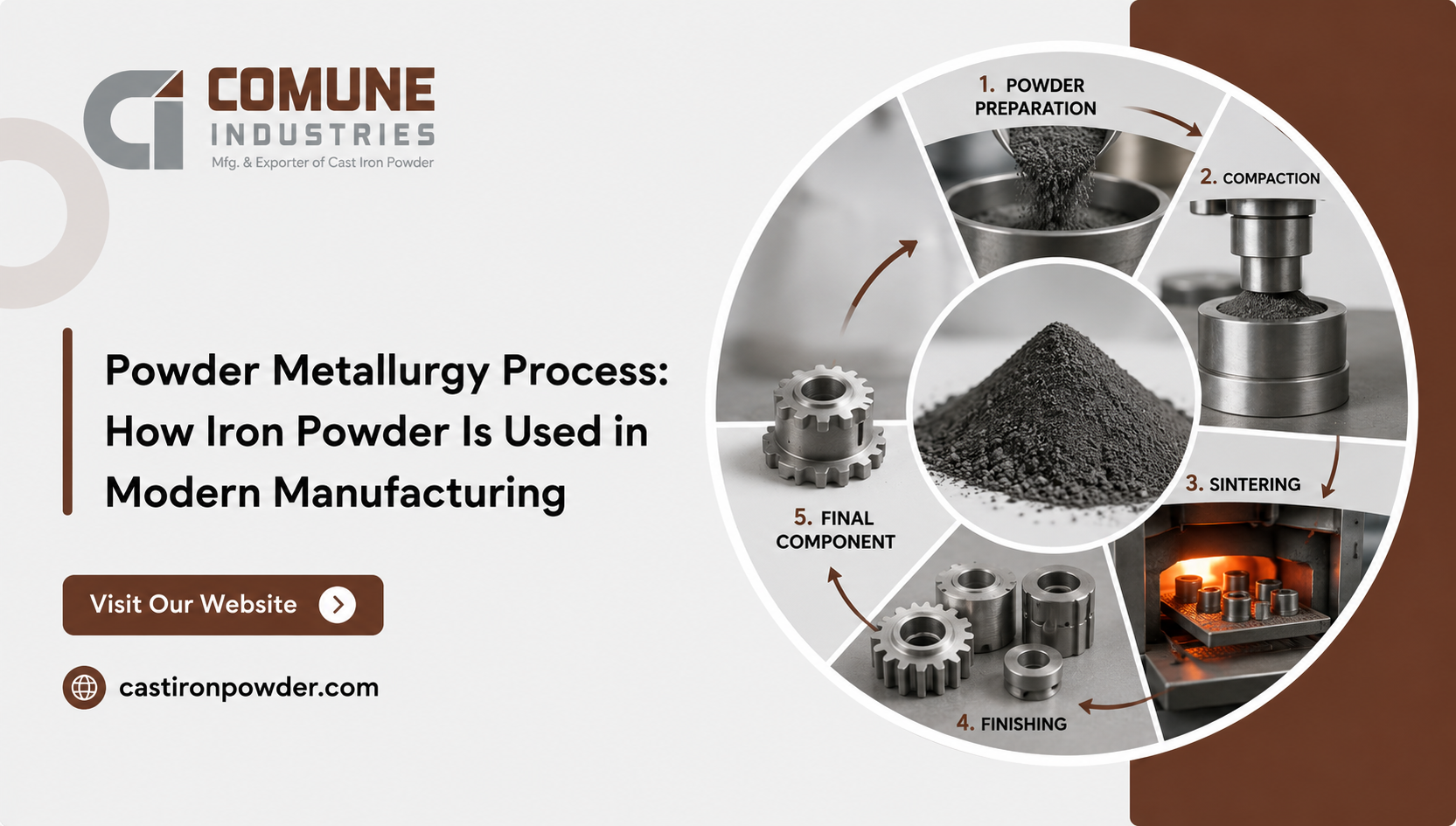
The powder metallurgy process includes several controlled steps. Each step plays an important role in final product quality.
Powder Production
This is the first step in metal powder processing.
Methods:
- Atomization: Molten metal is broken into fine droplets
- Reduction: Iron oxide is converted into iron powder
- Electrolysis: High-purity powder is produced
- Mechanical milling: Metal is crushed into fine powder
Benefits:
- Controlled particle size
- High purity
- Suitable for mass production
Powder Blending and Mixing
Here, iron powder is mixed with additives and lubricants.
Purpose:
- Improve flow of powder
- Ensure uniform composition
- Enhance pressing quality
Benefits:
- Consistent results
- Better mechanical properties
Powder Compaction
In this step, powder is pressed into shape using a die.
Process:
- Powder is filled in a mold
- High pressure is applied
- A “green compact” is formed
Benefits:
- High accuracy
- Low waste
- Suitable for mass production
Sintering Process
This is the most important step.
Process:
- Parts are heated below melting point
- Particles bond together
- Strength is developed
Benefits:
- High strength
- Better density
- Stable structure
Secondary Operations
After sintering, parts may undergo:
- Heat treatment
- Machining
- Surface finishing
- Coating
Benefits:
- Better performance
- Improved durability
Why Iron Powder Is Essential in Modern Manufacturing
Iron powder is widely used because it offers:
- High material efficiency
- Lower production cost
- Consistent quality
- Precision engineering
- Less material waste
- Energy savings
Moreover, these benefits make it ideal for industrial metal components.
Applications of Powder Metallurgy
Automotive Industry
- Gears
- Bearings
- Sprockets
- Engine parts
Industrial Machinery
- Pumps
- Compressors
- Hydraulic parts
Agriculture Equipment
- Gear systems
- Transmission parts
Aerospace Industry
- Lightweight components
- High-strength parts
Electrical Industry
- Magnetic parts
- Connectors
Construction Equipment
- Heavy-duty gears
- Wear-resistant parts
Benefits Compared to Traditional Manufacturing
|
Factor |
Powder Metallurgy |
Traditional Casting |
|
Cost |
Lower in mass production |
Higher machining cost |
|
Waste |
Very low |
High |
|
Precision |
High |
Medium |
|
Speed |
Fast for bulk production |
Slower |
|
Scalability |
Excellent |
Limited |
|
Environment |
More sustainable |
Less efficient |
Role of Iron Powder Manufacturers in India
India is growing fast in manufacturing. Demand for industrial metal powders in India is increasing due to:
- Automotive growth
- Engineering expansion
- Export demand
- Advanced manufacturing adoption
As a result, reliable iron powder suppliers in India and cast iron powder manufacturers such as COMUNE INDUSTRIES ensure a stable supply of high-quality materials for industrial applications.
How to Choose the Right Supplier
Choose a supplier based on:
- Product quality consistency
- Manufacturing capability
- Certifications
- Technical support
- Supply reliability
- Fair pricing
A good supplier reduces production risks.
Why Choose COMUNE INDUSTRIES
COMUNE INDUSTRIES is a trusted manufacturer and supplier of premium-quality iron powder and cast iron powder for diverse industrial applications. With a strong focus on quality, innovation, and customer satisfaction, the company supports manufacturers across automotive, engineering, machinery, and powder metallurgy sectors.
Future Trends in Powder Metallurgy
The industry is evolving with:
- Metal 3D printing
- Smart factories
- AI-based quality control
- Advanced powder engineering
- Sustainable production methods
These trends are shaping modern manufacturing.
Conclusion
The powder metallurgy process is a key technology in modern manufacturing. It helps industries produce strong, precise, and cost-effective components.
Iron powder and cast iron powder play a major role in automotive, machinery, and engineering industries. They improve efficiency, reduce waste, and support large-scale production.
As demand for iron powder manufacturers in India continues to grow, COMUNE INDUSTRIES continues to support industries with reliable, high-quality iron powder and cast iron powder solutions that meet modern manufacturing requirements.
For bulk industrial requirements, partnering with a trusted supplier ensures better performance and long-term production stability.