Two batches of iron powder can share the exact same chemical purity and still behave completely differently in production — simply because their particle size differs. Mesh size is one of the most overlooked specifications in iron powder procurement, yet it directly affects flowability, packing density, reactivity, and how consistently a part sinters or a chemical process performs. For buyers with specialized applications, working with a supplier that can deliver custom iron powder mesh sizes is often the difference between a material that merely meets spec and one that's actually optimized for the job.
This article breaks down what mesh size means, why it matters across industries, and what to look for in a supplier capable of true customization rather than a limited, one-size-fits-all product line.
Understanding Mesh Size
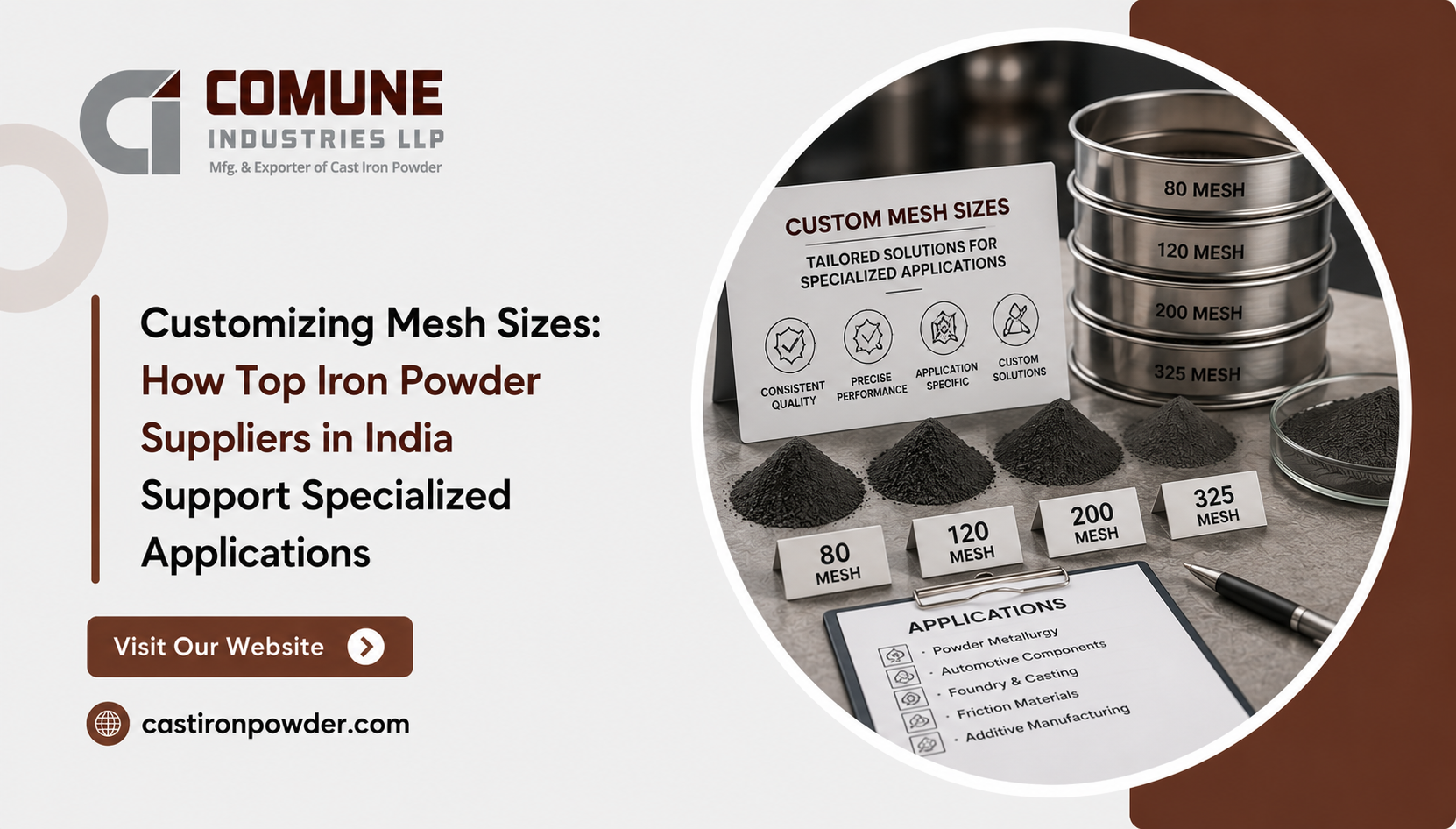
Mesh size refers to the number of openings per linear inch in a testing sieve, which correlates to particle size — a higher mesh number means smaller particles, since more openings fit into the same linear inch. Iron powder is typically sold across a range of mesh sizes, from coarser powders used in structural applications to extremely fine powders used in electronics or chemical processing.
Manufacturers determine mesh size distribution through sieve analysis, passing powder through a stack of sieves with progressively finer openings and measuring what percentage of material is retained at each level. This distribution — not just an average particle size — is what determines how a powder will actually behave in a buyer's process.
Why Mesh Size Matters
Mesh size affects several practical outcomes in production:
- Flowability: Finer powders tend to have different flow characteristics than coarser ones, affecting how evenly they fill a die or feed through automated equipment.
- Packing density: Particle size distribution determines how tightly powder particles pack together, which directly affects the density and strength of a sintered or compacted part.
- Surface area and reactivity: In chemical applications, finer mesh sizes offer greater surface area, increasing reactivity — critical in processes like nitrobenzene reduction where reaction efficiency depends on particle exposure.
- Surface finish: In powder metallurgy, mesh size influences the surface finish and dimensional precision of the final sintered part.
Because these outcomes vary so much by application, there's no universal "best" mesh size — the right specification depends entirely on what the buyer is producing.
Industries Requiring Customized Mesh Sizes
Different industries gravitate toward different mesh ranges based on their process requirements:
- Powder metallurgy manufacturers often need specific, narrow mesh distributions to achieve consistent part density and dimensional accuracy across high-volume production runs.
- Welding consumable manufacturers require mesh sizes suited to how the powder integrates into electrode coatings or flux formulations.
- Automotive component manufacturers, particularly those producing friction materials or sintered parts, rely on mesh consistency to meet OEM tolerance requirements.
- Chemical processing applications often call for finer mesh sizes to maximize surface area and reaction efficiency.
- Electronics manufacturers producing magnetic components or shielding materials typically require very fine, tightly controlled mesh distributions for consistent electrical and magnetic performance.
How Manufacturers Produce Different Mesh Sizes
Producing a range of mesh sizes starts with the production method itself — atomization, reduction, or electrolysis — each of which naturally yields different base particle characteristics. From there, manufacturers use mechanical sieving and classification equipment to separate powder into specific mesh fractions, blending or further processing as needed to hit a buyer's target specification.
Suppliers offering genuine iron powder mesh size customization typically maintain multiple sieving and classification lines, allowing them to isolate narrow mesh ranges rather than offering only a handful of fixed, broad categories. This flexibility is what separates a manufacturer that can serve specialized, technical buyers from one limited to standard commercial grades.
Choosing the Right Mesh Size
Selecting the correct mesh size comes down to understanding your specific process requirements:
- Define the end application — Is the powder going into a sintered part, a chemical reaction, or a welding consumable? Each has a different tolerance for particle size variation.
- Consider flow and packing requirements — Automated production lines often need specific flow characteristics that only certain mesh ranges can deliver.
- Test before committing to volume — Requesting a sample in your target mesh range and running it through your actual process is the most reliable way to confirm fit.
- Consult with the supplier's technical team — An experienced iron powder supplier India buyers can rely on should be able to recommend a starting mesh specification based on your described application, even before a sample is tested.
Benefits of Customization
Working with a supplier that supports mesh size customization offers several advantages over sourcing only standard grades:
- Better process performance, since powder tailored to your specific equipment and application reduces variability in output
- Reduced waste, as correctly matched mesh sizes minimize rework or scrap caused by inconsistent packing or flow
- Competitive differentiation, particularly for buyers producing precision components where standard-grade powder simply won't meet tolerance
- Flexibility to adapt, allowing buyers to adjust specifications as their own product designs or processes evolve, without switching suppliers entirely
Why Comune Industries Offers Flexible Manufacturing
Comune Industries has built a manufacturing base that supports specialized iron powder applications across a range of mesh requirements, including:
- Four dedicated production lines, supporting a combined capacity of 1,500 tons per month, with the flexibility to allocate production toward specific mesh specifications
- In-house laboratory and spectrometer testing, ensuring both chemical composition and particle size distribution are verified for every batch
- A product range spanning iron powder, reduction-grade iron powder, iron metal powder, and cast iron powder, reflecting experience across multiple particle size and application requirements
- ISO 9001:2015 and ISO 14001:2015 certification, along with GMP compliance, supporting a consistent, documented approach to production quality
- Decades of manufacturing experience, dating back to 1988, giving the company a deep working knowledge of how mesh size affects performance across industries
For buyers whose applications demand more than an off-the-shelf mesh grade, working with a manufacturer capable of true customization — rather than a limited standard catalog — makes it far easier to source powder that actually fits the process.
Conclusion
Mesh size is far from a minor technical detail — it's a specification that directly shapes how iron powder performs in your specific process, whether that's sintering, welding, chemical reaction, or electronics manufacturing. Buyers who work with suppliers capable of true mesh size customization, rather than settling for standard commercial grades, gain a meaningful advantage in process consistency and part quality.
With decades of manufacturing experience and the production flexibility to support varied specifications, manufacturers like Comune Industries offer buyers a path to sourcing iron powder that's genuinely matched to their application — not just close enough.